
Why insulation comes first
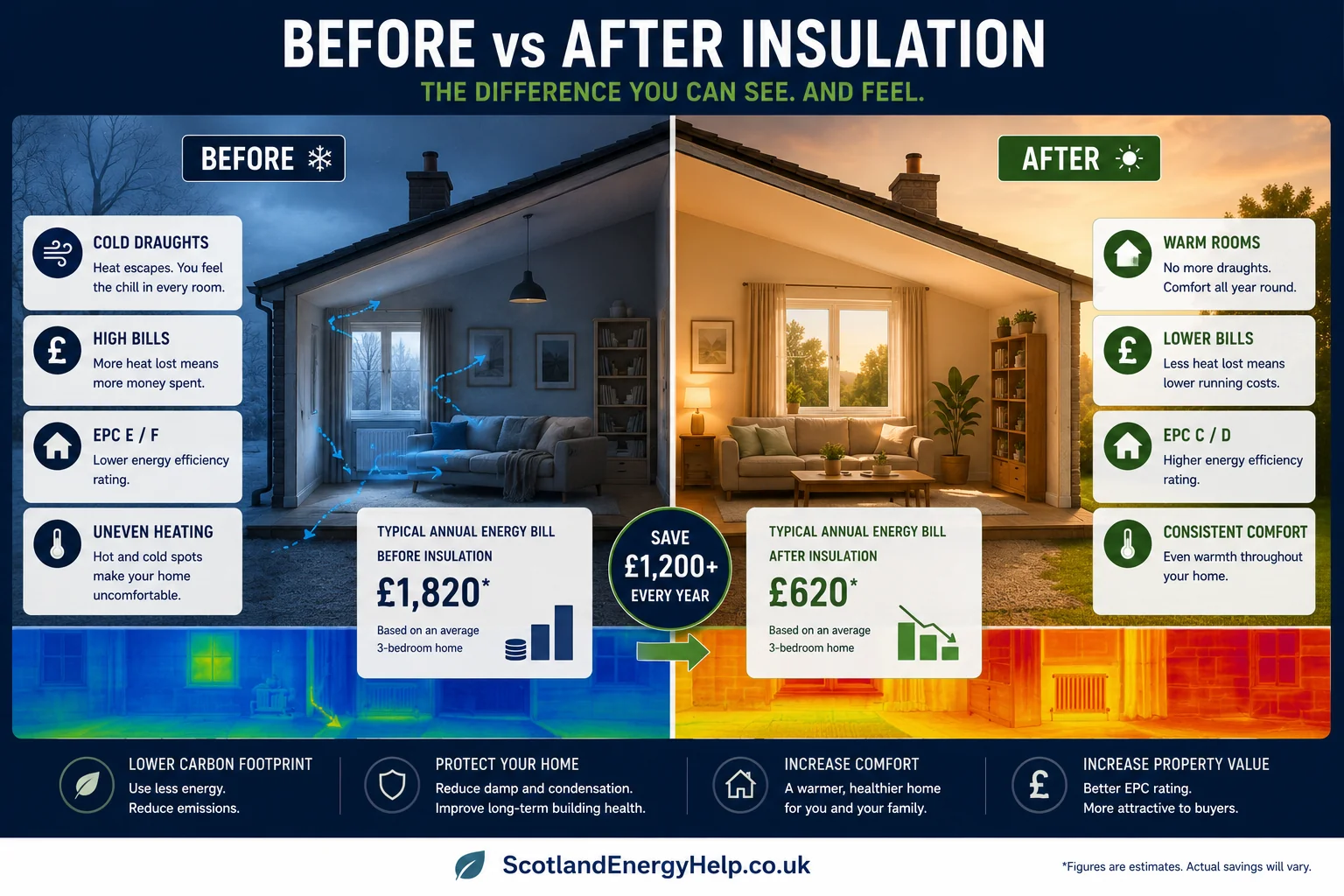
Insulation is consistently the most cost-effective first step in any home energy improvement programme. Before upgrading your heating system, before installing solar panels, before replacing windows — insulating your home properly reduces the energy you need to generate and the money you spend generating it.
In Scotland, there is substantial grant funding available for insulation in 2026, through several different schemes depending on your circumstances.
Loft insulation
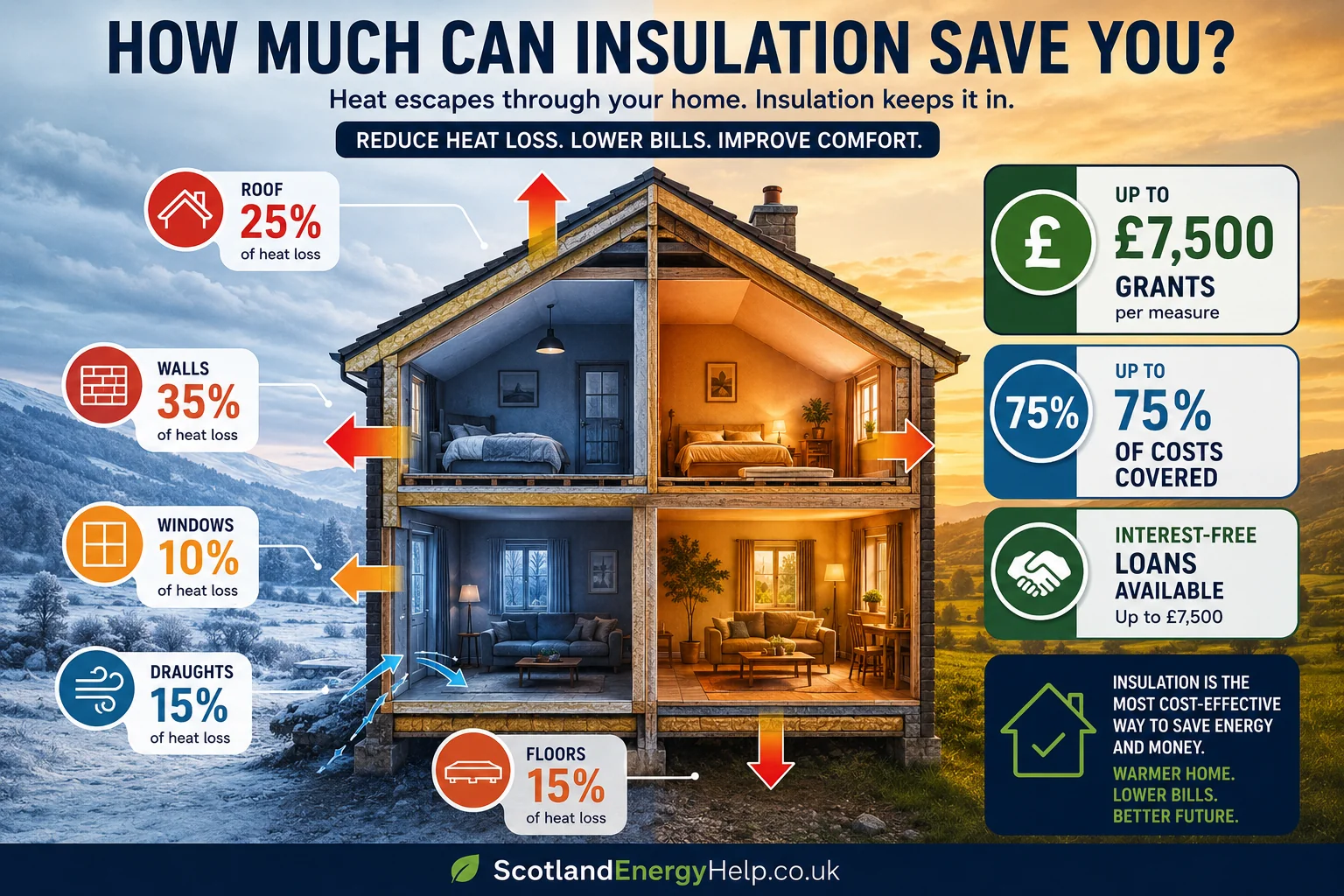
For homes with accessible loft spaces, loft insulation is typically the single highest-impact, lowest-cost improvement available. Standard loft insulation to a depth of 270mm costs around £300 to £600 for most homes and can reduce heat loss through the roof by up to 25%.
The Home Energy Scotland scheme funds loft insulation at up to 75% of costs, with a maximum grant of £7,500 — more than covering most standard loft insulation jobs.
Cavity wall insulation
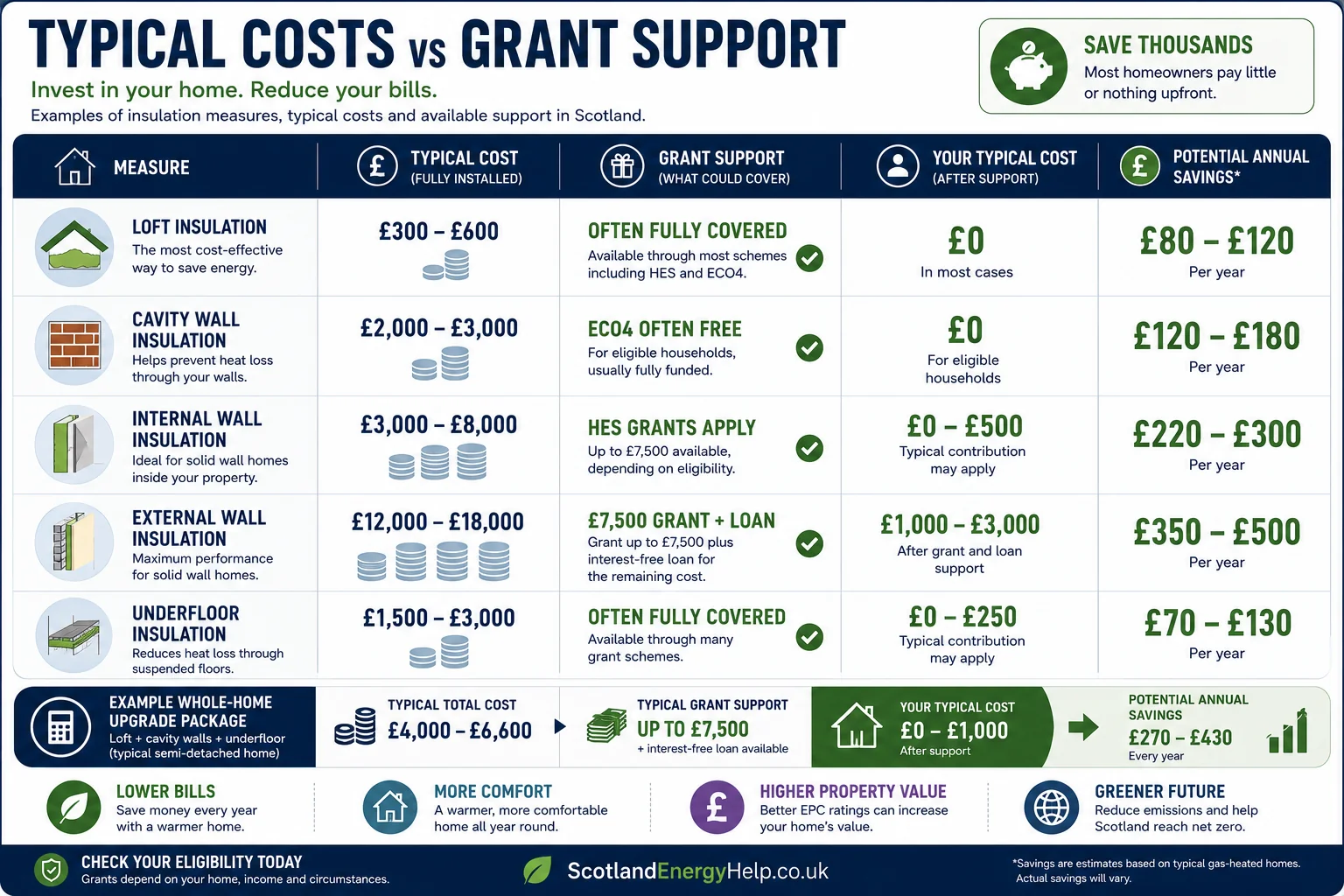
Homes built after approximately 1920 typically have cavity walls — two layers of brick or block with a gap between them. Filling this cavity with insulation material is one of the most cost-effective measures available, typically costing £2,000 to £3,000 for a standard house.
Cavity wall insulation is frequently funded through ECO4 at no cost for qualifying households. For those not qualifying for ECO4, HES loan funding is available.
Solid wall insulation — external (EWI)
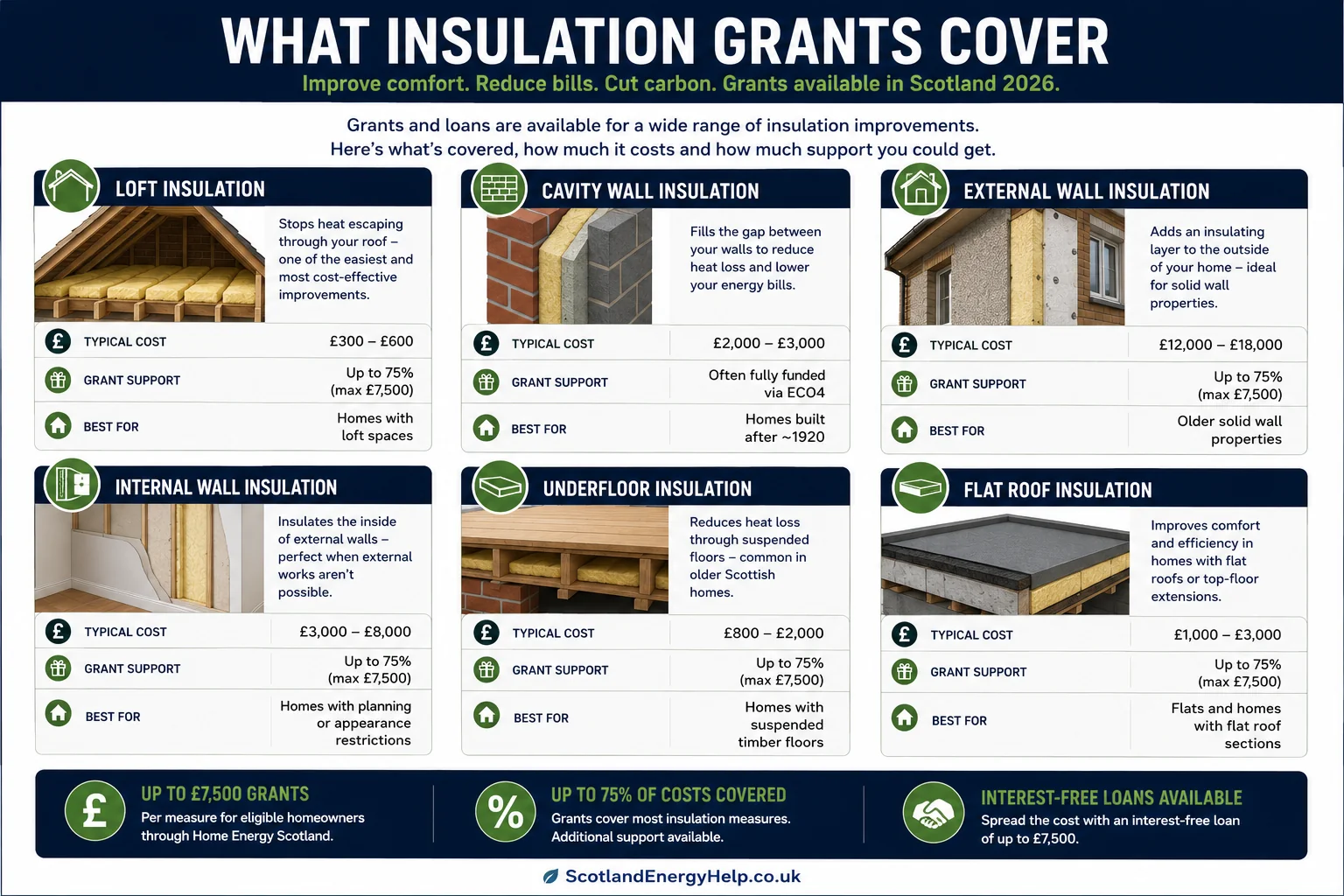
For older homes with solid walls — particularly traditional sandstone properties and pre-1920 stone-built homes — external wall insulation involves attaching an insulating layer to the outside of the building and rendering or cladding over it. Typically £12,000 to £18,000 for a full house, but more effective for properties where cavity fill is not an option.
HES grants of up to £7,500 are available for solid wall insulation, with a loan covering remaining costs. TrustMark-registered installers are required.
Solid wall insulation — internal (IWI)
Where external insulation is not feasible — due to planning restrictions, conservation area rules or building appearance — internal wall insulation applies insulated boards or thermal plaster to the inside face of external walls. It reduces internal floor area slightly but avoids the exterior complications.
Costs vary by property size and specification, typically £3,000 to £8,000 for a flat or smaller house. HES grants apply.
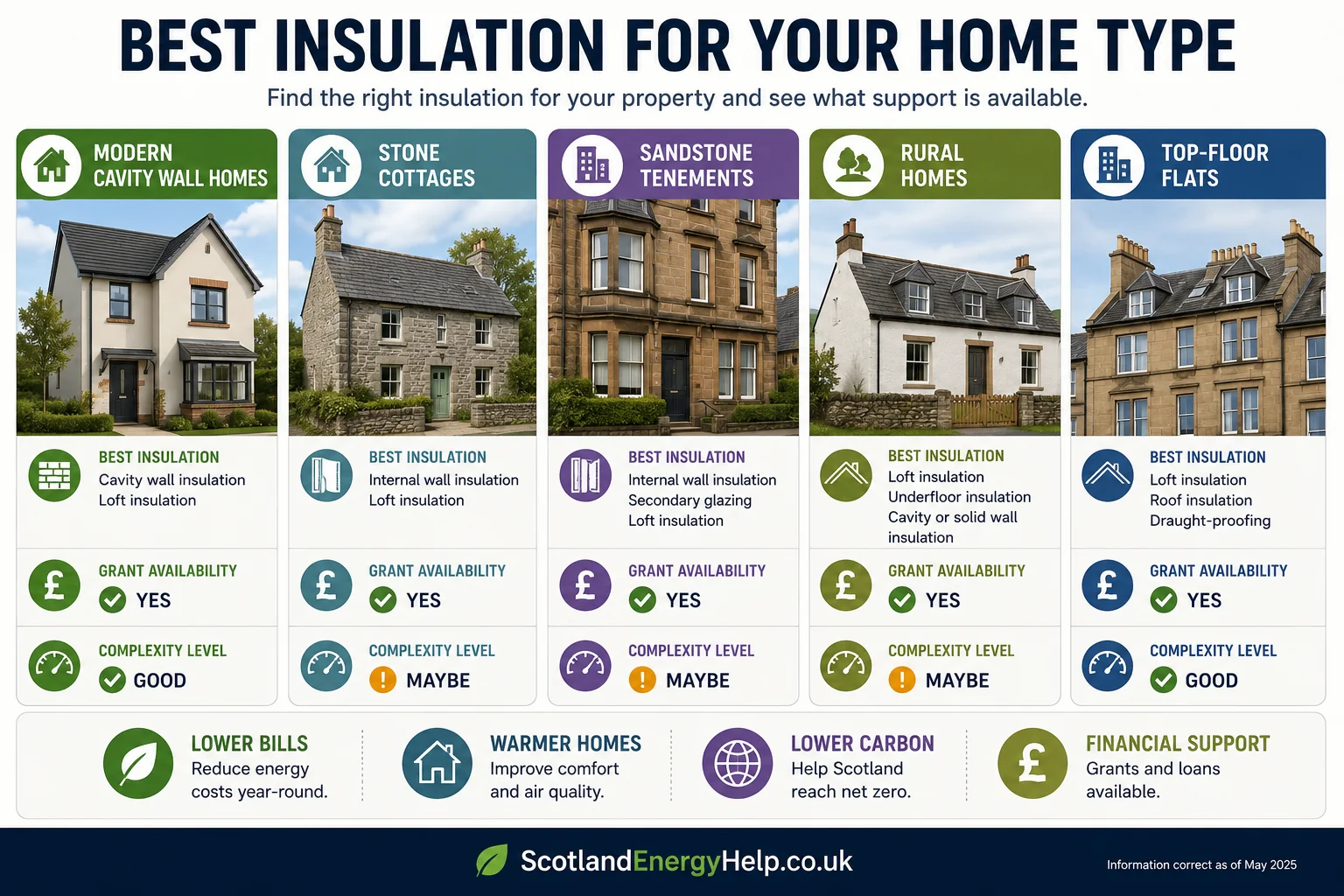
Flat roof and underfloor insulation
Top-floor flats and properties with flat roof sections can insulate these areas, typically from above (warm roof construction) or from below. HES grants cover flat roof insulation at up to 75% of costs.
Homes with suspended timber floors — common in older Scottish properties — lose significant heat through air movement under the floor. Insulating between joists from below, where accessible, is relatively inexpensive and effective.
Which scheme applies to you?
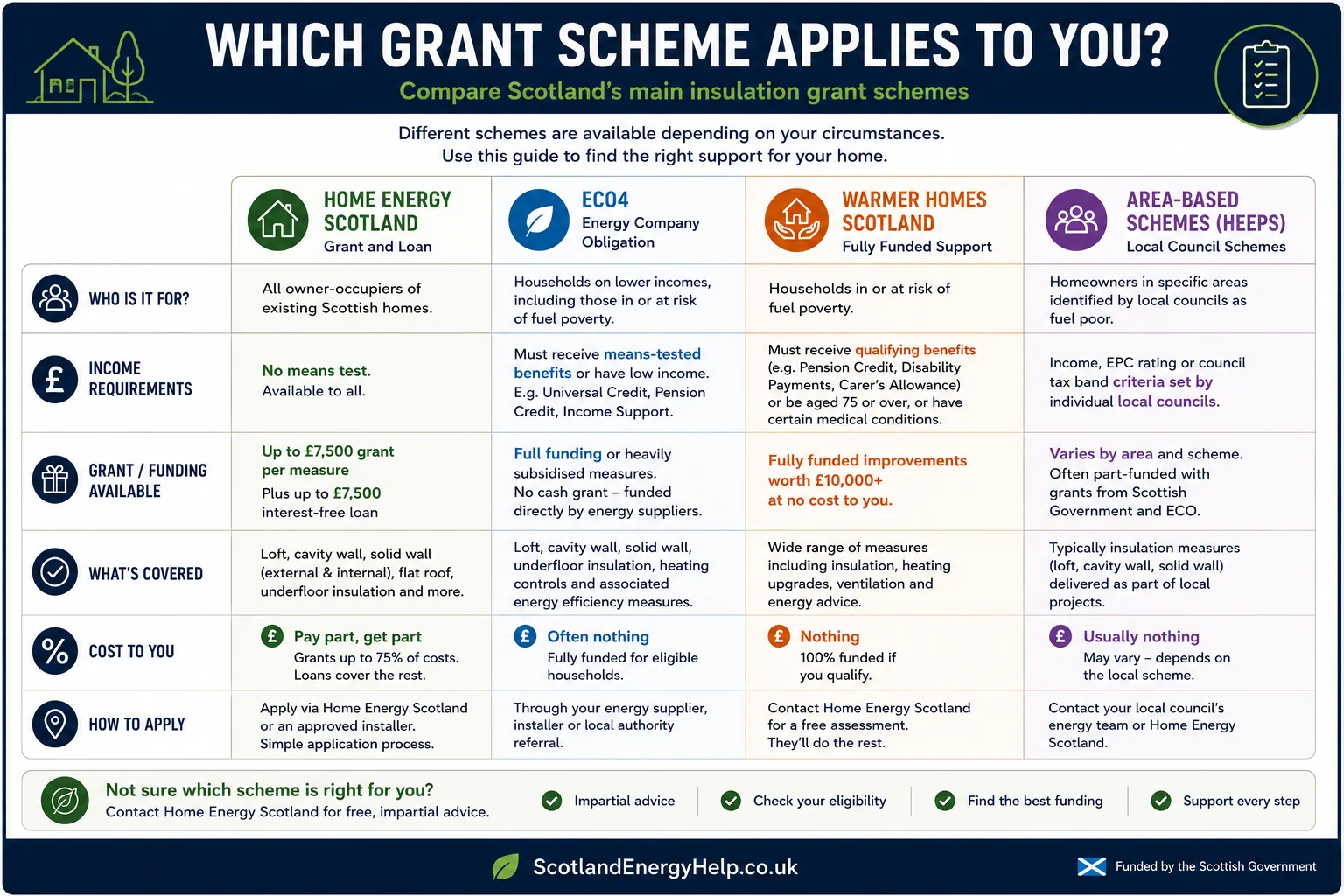
Home Energy Scotland Grant and Loan: available to all owner-occupiers regardless of income. Grants up to £7,500 per measure, loans up to £7,500, plus £1,500 rural uplift. No means test — the primary route for most homeowners.
Warmer Homes Scotland: for households in or at risk of fuel poverty. Fully funded at no cost. Eligibility requires qualifying benefits — Pension Credit, Carer's Allowance, Disability Payments — being aged 75+, or holding certain medical certificates.
ECO4: UK-wide energy supplier obligation running to March 2026, targeting households on means-tested benefits with free or heavily subsidised insulation. Includes an off-gas rural uplift in Scotland.
Area-Based Schemes (HEEPS): Scottish councils run whole-street insulation projects in fuel-poor neighbourhoods. Eligibility varies by council — contact your local energy team or HES.
The EPC connection
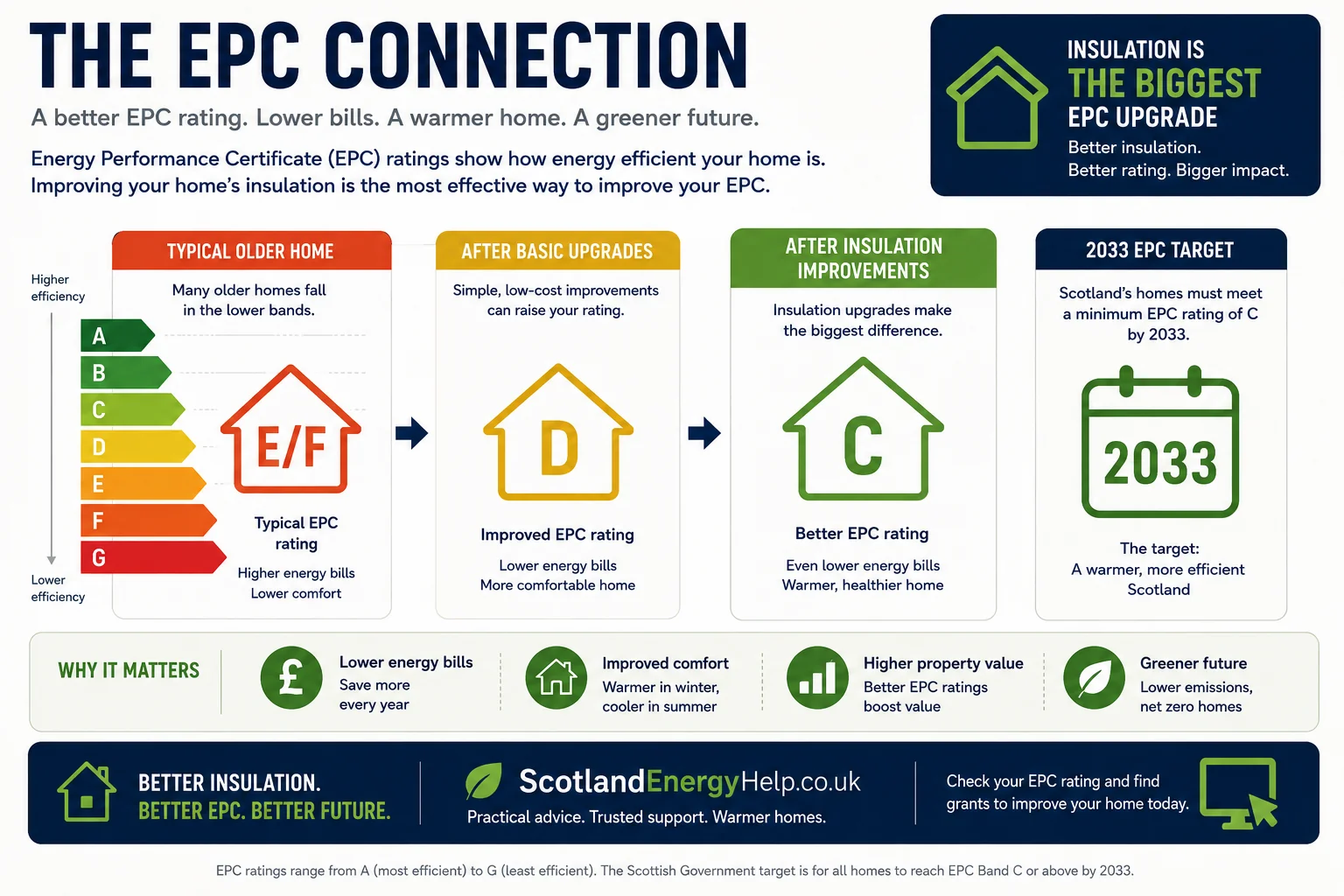
Your Energy Performance Certificate rating reflects the thermal efficiency of your home. Improving insulation is the single most reliable way to improve an EPC rating.
From 2026, EPC certificates in Scotland will be updated with new ratings and validity will reduce from 10 years to five. Proposed legislation would require all owner-occupied homes to reach EPC band C by 2033 — for many older stone-built properties and tenements, this will require a combination of insulation improvements.
Getting insulation installed safely
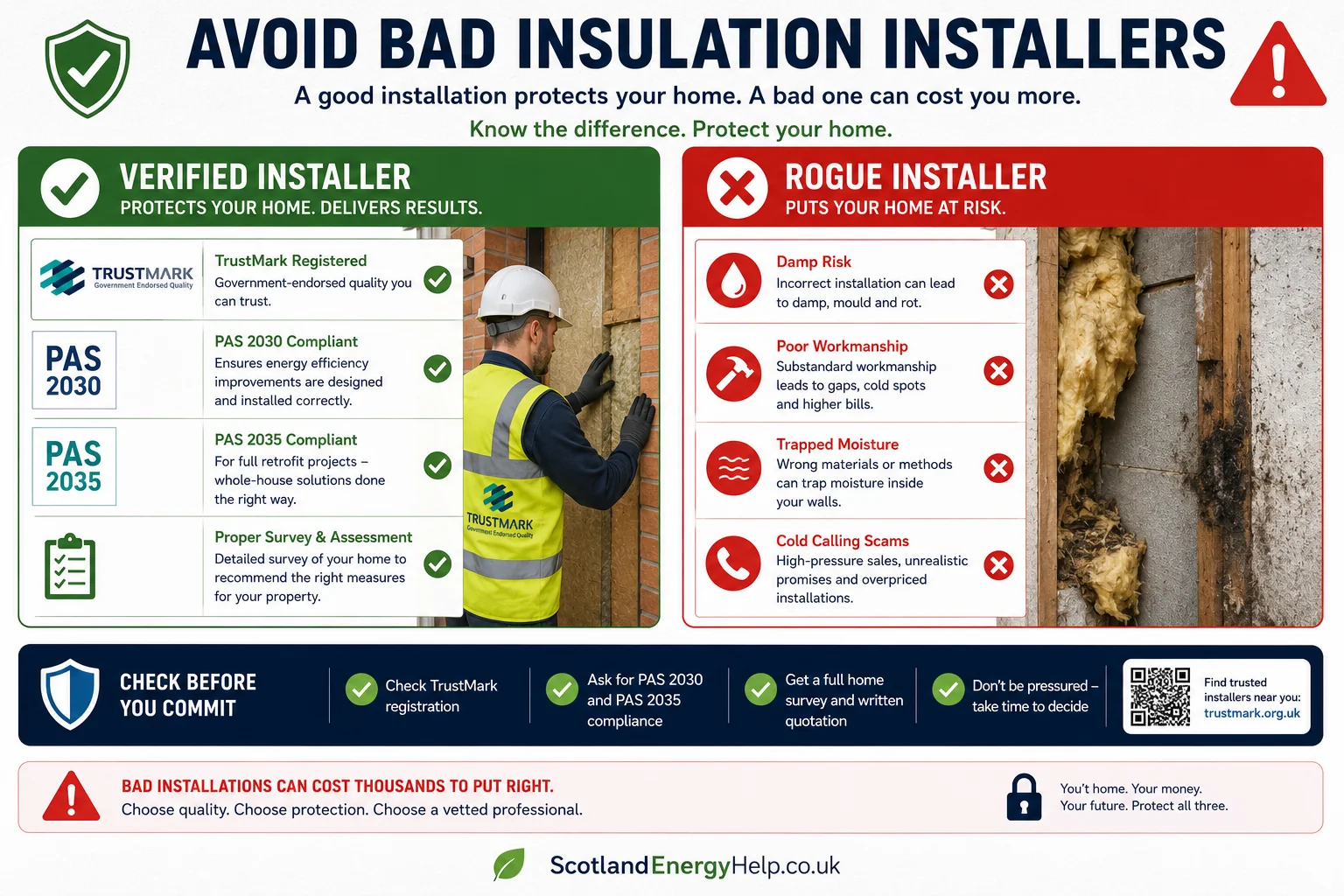
The insulation market has a history of poor quality installation and in some cases outright fraud. Cavity wall insulation installed incorrectly can cause dampness and structural damage. External wall insulation installed without proper detailing can trap moisture. These risks are not reasons to avoid insulation — they are reasons to use properly registered installers.
For external/internal wall insulation and flat roof works funded through HES, TrustMark registration is required. Verify at trustmark.org.uk before signing any contract. For ECO4 funded works, installers must be registered under PAS 2030 and PAS 2035 standards.
Frequently asked questions
Can I insulate a sandstone wall?+
Yes, but use a breathable system (woodfibre or hempcrete). Standard PIR boards trap moisture and cause damp. See Guide 09.
Do I need to be on benefits to get insulation grants?+
No. The Home Energy Scotland Grant and Loan is open to all owner-occupiers regardless of income. Warmer Homes Scotland and ECO4 are the income-based routes that offer fully funded measures.
How do I check my installer is properly registered?+
For HES-funded wall insulation, search trustmark.org.uk. For ECO4 work, ask for the installer's PAS 2030/2035 certification — any reputable firm will provide it on request.
Get this as a branded PDF
Save it, print it, share it with your contractor.