

Why Warmer Homes Scotland matters
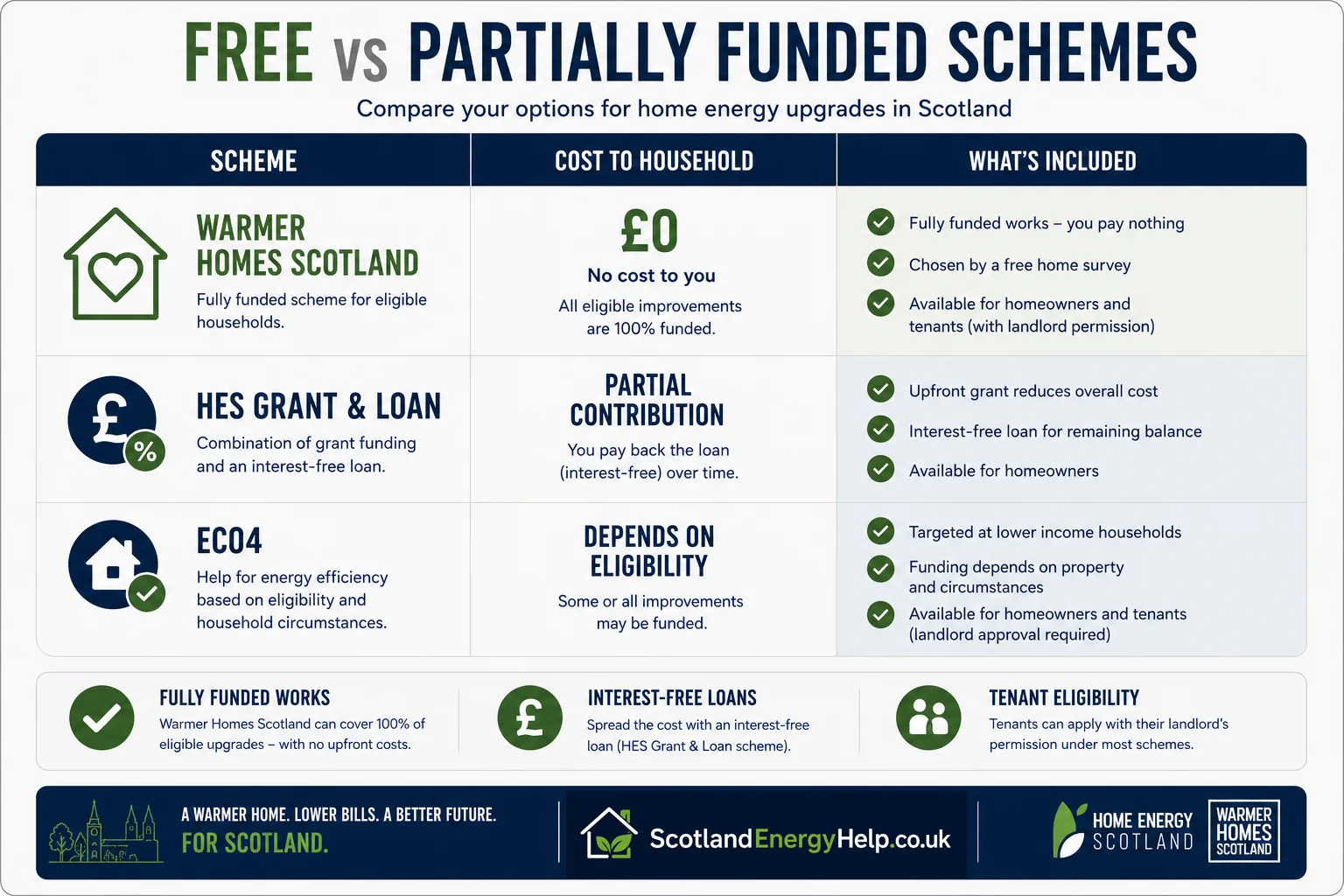
Warmer Homes Scotland is the Scottish Government's scheme for households in or at risk of fuel poverty. Unlike the Home Energy Scotland Grant and Loan — which requires the homeowner to contribute toward costs — Warmer Homes Scotland provides fully funded improvements at no cost to the household.
For eligible households, this is the most valuable scheme available. Works delivered under Warmer Homes Scotland can be worth £10,000 or more, covering heating systems, insulation, draught proofing and other measures, all arranged and paid for by the scheme.
Who Warmer Homes Scotland is for
The scheme targets owner-occupiers and private tenants living in fuel poverty or at risk of it. Social housing tenants — those renting from a council or housing association — are not eligible as their landlords have separate obligations.
Eligibility is based on the circumstances of the people living in the home rather than the property itself. You are likely to qualify if your household includes someone who meets one of the following:
Age and heating: someone aged 75 or over with no working central heating system in the home.
Passport benefits: a household member receives Pension Credit (Guarantee or Savings Credit), Carer's Allowance, Disability Living Allowance, Personal Independence Payment, Attendance Allowance, Child Disability Payment, Adult Disability Payment, or Universal Credit with a limited capability for work element.
Medical certificates: the household holds a DS1500 or BASRiS medical certificate, relating to a terminal illness or serious medical condition.
Urgent need: in some circumstances, households with an urgent heating need — for example, a broken boiler with no alternative heating and a vulnerable occupant — may qualify for prioritised support.
If you are unsure whether your circumstances qualify, contact Home Energy Scotland directly and describe your situation. The advisers are experienced at identifying eligibility and will not make you feel as though you are wasting their time.

What works are covered
Warmer Homes Scotland is a whole-home programme rather than a grant for a single measure. When you are assessed, an adviser and surveyor look at your home as a complete system and identify the combination of improvements that will make the most difference to warmth and running costs.
Heating systems: replacement of broken or inefficient heating systems — including boiler replacement, heat pump installation, replacement of storage heaters and installation of new central heating in homes that currently have none.
Insulation: loft insulation, cavity wall insulation, solid wall insulation (internal or external where feasible), floor insulation and flat roof insulation depending on the property type and what is cost-effective.
Draught proofing: sealing gaps around doors, windows, floorboards and pipework, often included as part of a broader improvement package.
Other measures: energy-efficient lighting, heating controls and ventilation where required.
The combination of measures delivered is determined by the assessment, not by the household. You cannot choose specific works — the programme delivers what the survey identifies as most effective.

Example improvements you could receive
Improvements are tailored to your home and chosen by a free survey. A typical package may include loft insulation, draught proofing, boiler replacement, heat pump installation and radiator upgrades — bundled together for maximum impact.
The whole-home approach means measures are sequenced and combined to deliver lasting comfort and the lowest running costs, not just one quick fix.

What a typical package is worth
Heating systems (e.g. heat pump): £4,000–£10,000. Insulation (loft, walls, floors): £2,000–£8,000. Draught proofing, heating controls and radiator upgrades are typically included.
Total package value can comfortably exceed £10,000 — fully funded, with no cost to you or your landlord.

The application process step by step
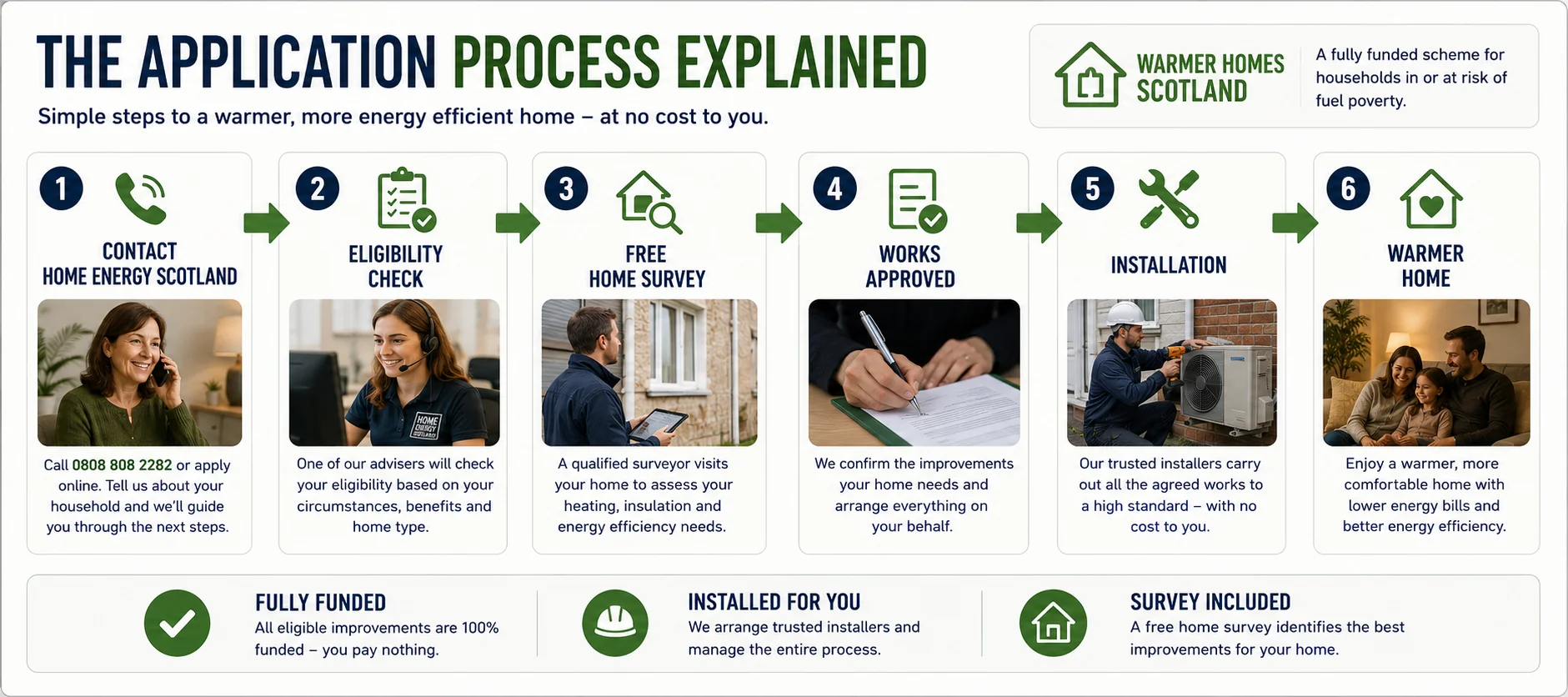
Step one — Contact Home Energy Scotland: call 0808 808 2282 or apply online at homeenergyscotland.co.uk. Explain that you are enquiring about Warmer Homes Scotland and describe your household circumstances. The call is free.
Step two — Initial eligibility check: an HES adviser will confirm whether your household is likely to qualify based on your circumstances, property type and tenure.
Step three — Home survey: if you appear eligible, a surveyor will visit your home to assess its condition and determine what the scheme can deliver. This survey is free.
Step four — Works arranged: HES arranges a contractor to carry out the identified works. You do not source or manage the contractor yourself. Works are carried out at no cost to you.
Step five — Completion: on completion, your home should be warmer, cheaper to heat and potentially improved in EPC rating. A follow-up assessment confirms the improvements delivered.
Why a proper survey matters
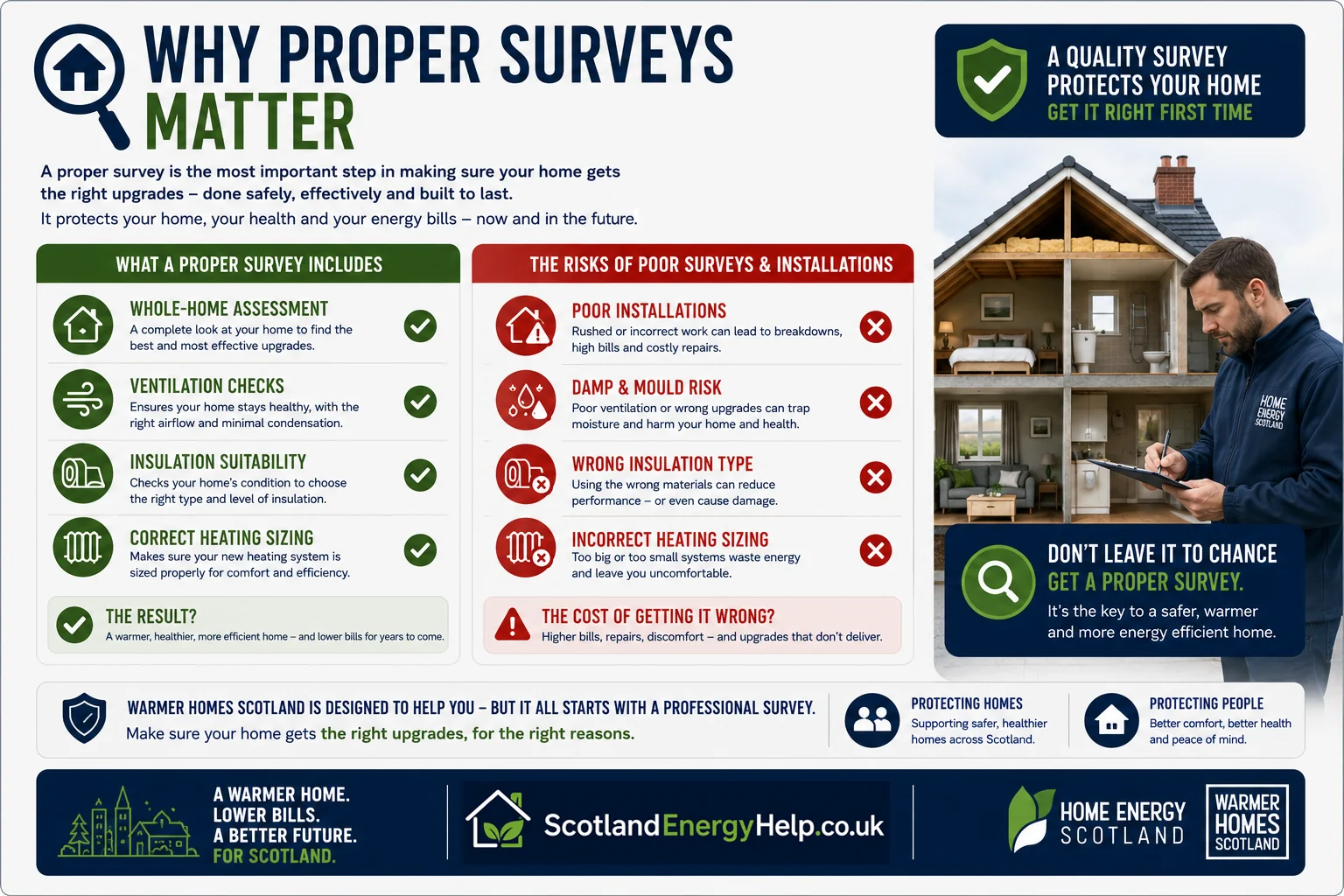
A proper survey is the most important step in making sure your home gets the right upgrades — done safely, effectively and built to last. It includes a whole-home assessment, ventilation checks, insulation suitability and correct heating sizing.
Poor surveys lead to poor installations: damp and mould risk, the wrong insulation type, incorrectly sized heating systems and higher bills. Warmer Homes Scotland is designed to get this right first time using approved contractors.
Urgent heating support
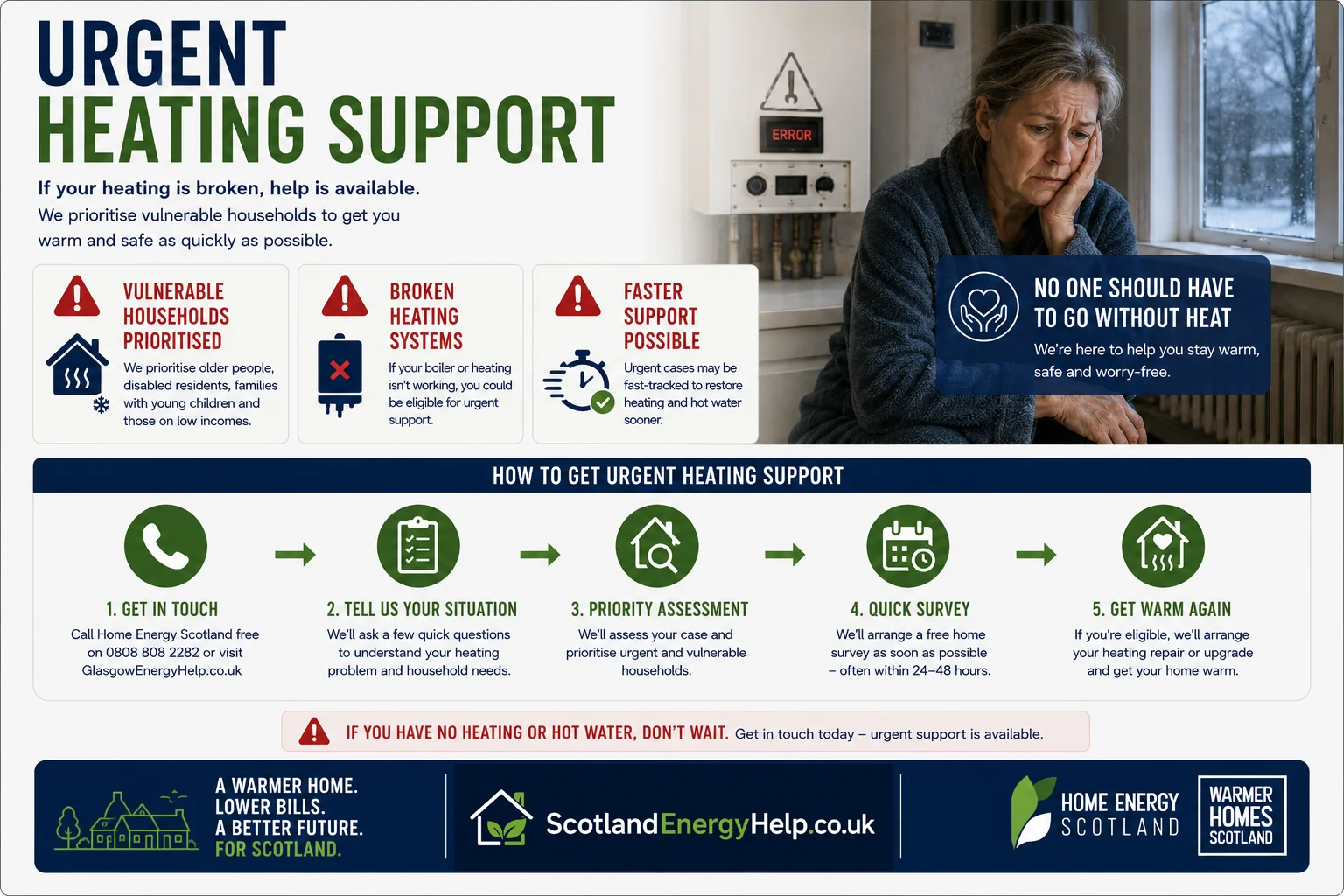
If your boiler or heating has failed and there is a vulnerable person in the household, urgent cases can be fast-tracked. Home Energy Scotland prioritises older people, disabled residents, families with young children and those on low incomes.
Urgent home surveys can often be arranged within 24–48 hours. If you have no heating or hot water, do not wait — call Home Energy Scotland on 0808 808 2282 today.
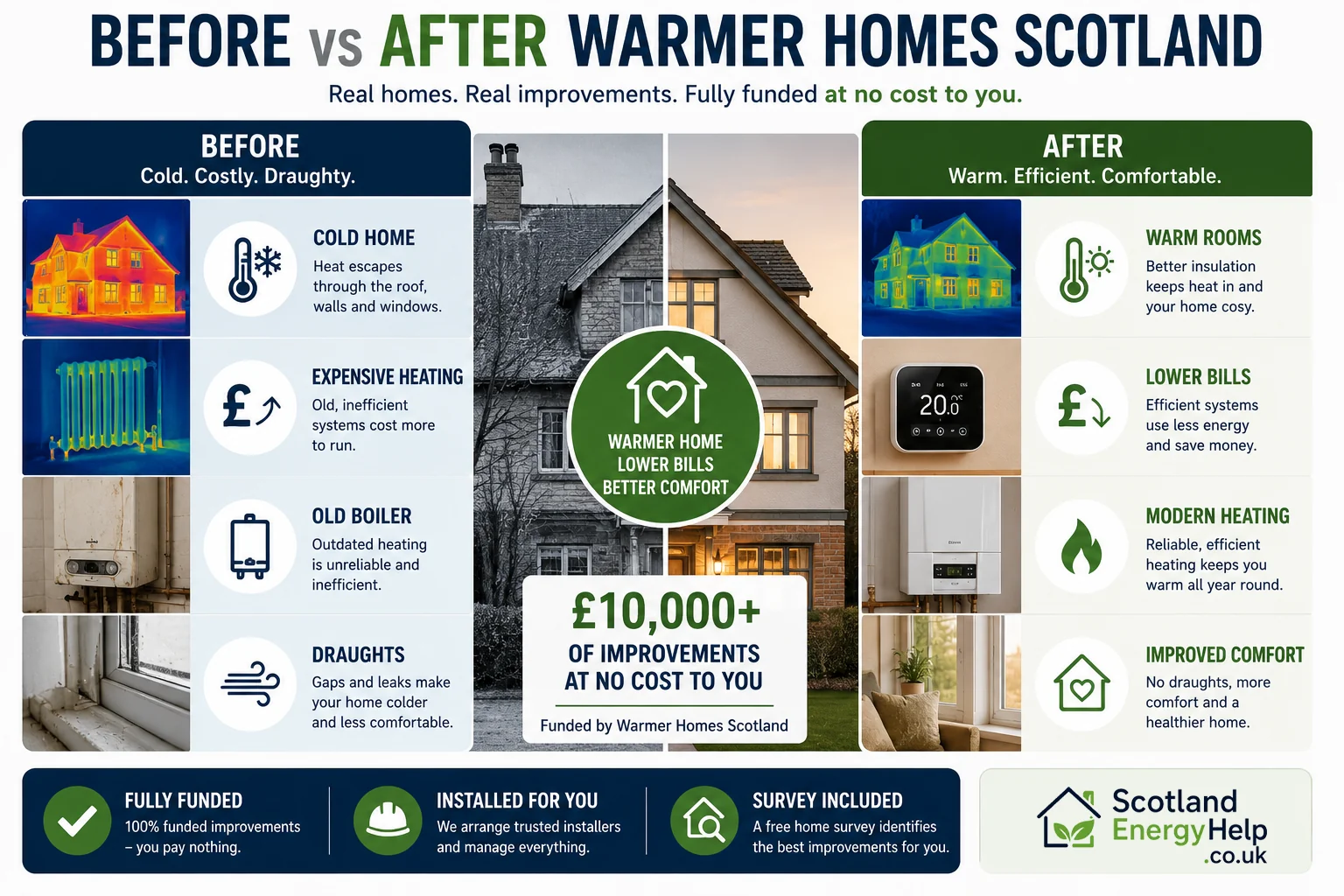
The real impact: before and after
Households who go through the scheme typically move from cold, draughty, expensive-to-heat homes to warm, efficient, comfortable ones — with modern heating, better insulation and lower bills.
It is not unusual for a single visit to deliver £10,000+ of improvements that transform comfort and running costs for years.
What if you do not qualify
If your household does not meet the Warmer Homes Scotland eligibility criteria, you are not without options.
The Home Energy Scotland Grant and Loan is available to all owner-occupiers of Scottish homes regardless of income, with grants up to £7,500 per measure and interest-free loans covering remaining costs.
ECO4, if you or a household member receives means-tested benefits, may fund insulation or heating upgrades through your energy supplier at no cost.
Area-based schemes run by local councils target specific neighbourhoods with whole-street improvement programmes. Contact your local council energy team or HES to find out what is available in your postcode.

Private tenants: what to know
Private tenants can apply for Warmer Homes Scotland with their landlord's permission. There is no cost to either you or your landlord — all eligible improvements are 100% funded.
Without landlord consent, works cannot proceed. If you need help approaching your landlord, Home Energy Scotland advisers can support that conversation and explain the benefits to the property.

Avoiding scams
Warmer Homes Scotland NEVER cold-calls, texts or door-knocks. The only legitimate route is to contact Home Energy Scotland on 0808 808 2282 or via homeenergyscotland.co.uk. Anyone claiming to be 'from the government' offering free insulation at your door is a scam.
Frequently asked questions
Can private tenants apply?+
Yes. Warmer Homes Scotland is available to private tenants as well as owner-occupiers, provided the eligibility criteria are met. The landlord's consent is required for works affecting the property structure. For qualifying tenants whose landlord agrees, works are carried out at no cost to either party.
Does it matter what EPC my home currently has?+
No. There is no minimum or maximum EPC requirement for Warmer Homes Scotland. The scheme is focused on household need, not property rating.
Will the works be disruptive?+
Works vary in disruption depending on what is being done. Loft insulation is quick and minimally disruptive. Heating system replacement is more involved and may require the heating to be off for a period. The contractor will discuss timing and logistics with you before works begin.
What happens if I am a tenant and my landlord refuses to allow works?+
Warmer Homes Scotland works require landlord consent. If a landlord refuses, the works cannot proceed. This is a known limitation of the scheme for private tenants. Citizens Advice Scotland may be able to advise on your options.
Will I get a heat pump under WHS?+
Sometimes. The scheme prioritises the most cost-effective measures first. If your home would benefit more from insulation, that comes first.
Get this as a branded PDF
Save it, print it, share it with your contractor.