
Scotland's stone-built housing stock
Scotland has an extraordinary stock of Victorian and Edwardian stone-built homes. Detached and semi-detached sandstone villas, stone terraces, granite farmhouses and Georgian townhouses define the character of Scottish towns and cities. They are beautiful, solidly built and often deeply inefficient to heat.
If you own one of these properties, you face a specific set of retrofit challenges that generic UK energy advice does not address well. This guide covers what the options are, what they cost, and what grant support is available.

Why stone walls are a problem
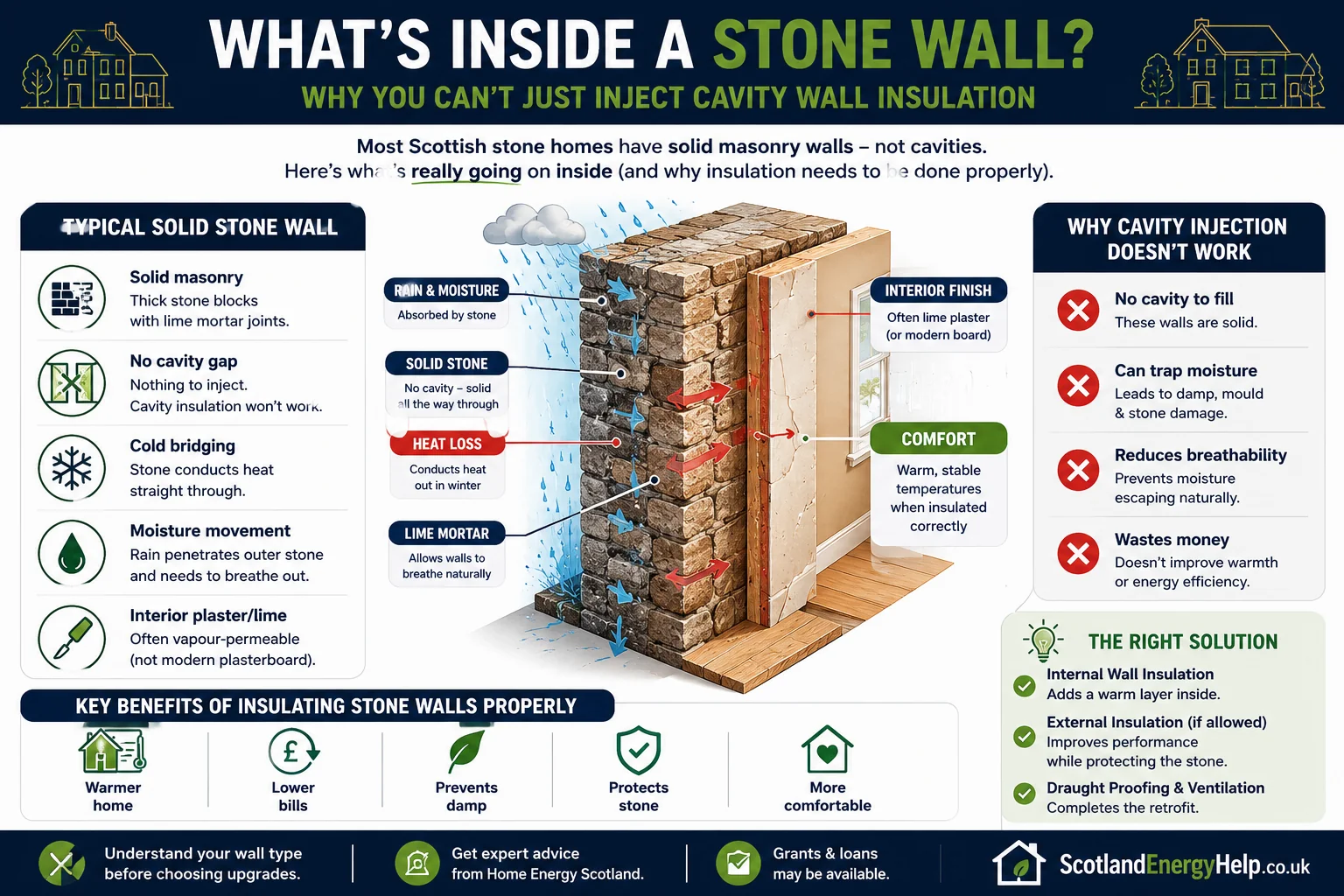
The fundamental challenge of a stone-built home is the wall construction. Traditional Scottish stone walls — whether sandstone in Glasgow and the west, granite in Aberdeen and the north-east, or other local stone — are solid masonry with no cavity. There is no air gap to fill with insulation, no straightforward technical fix.
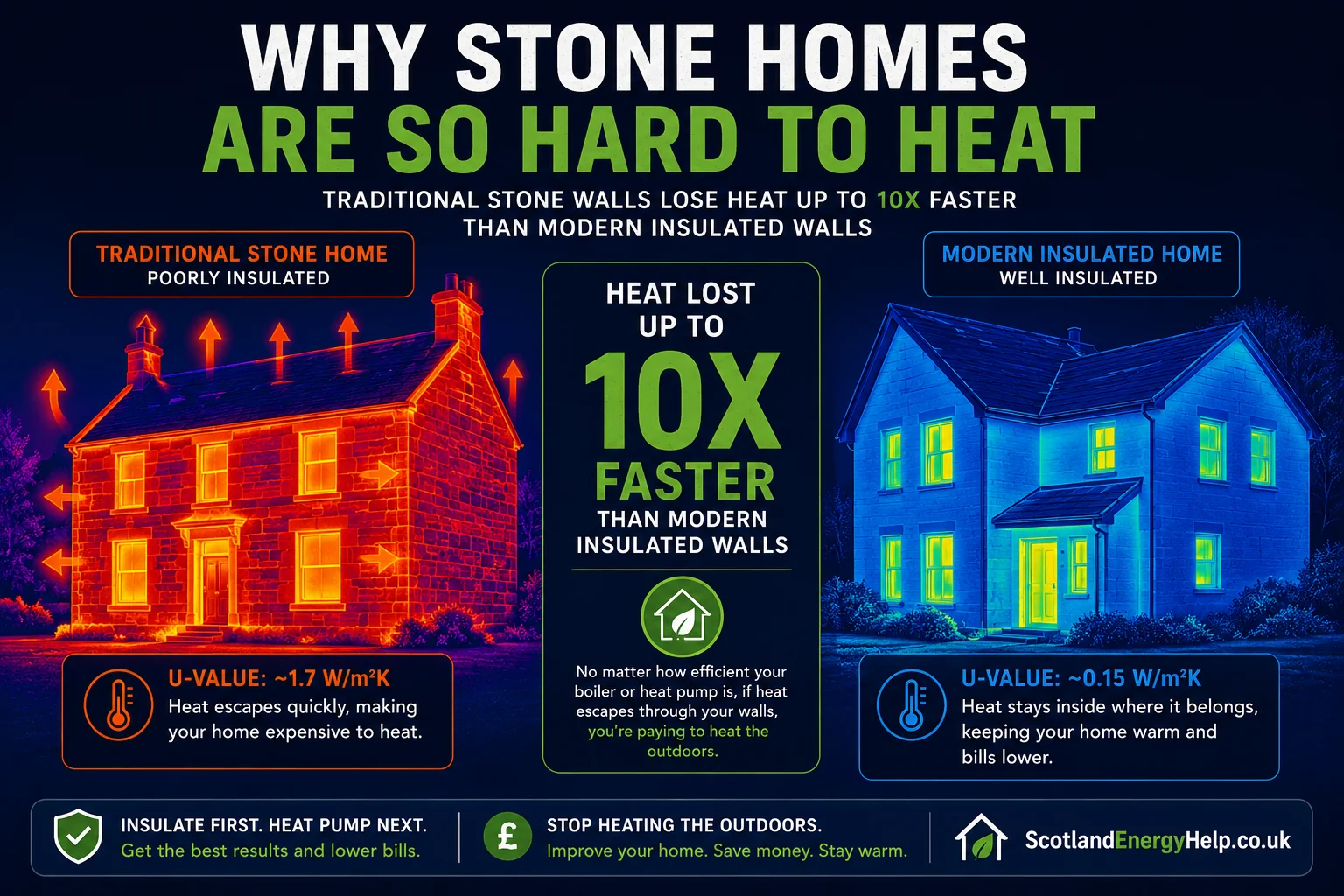
Stone is a reasonable structural material and a poor insulator. A solid sandstone wall 600mm thick has a U-value — a measure of heat loss — of approximately 1.7 W/m²K. A well-insulated modern wall has a U-value of around 0.15 W/m²K. The stone wall loses heat more than ten times faster than a modern insulated wall.
This matters because no matter how efficient your boiler or heat pump is, if the heat it generates is escaping through your walls at that rate, you are paying to heat the outdoors. Addressing the walls is the single most impactful thing most stone home owners can do.
External wall insulation
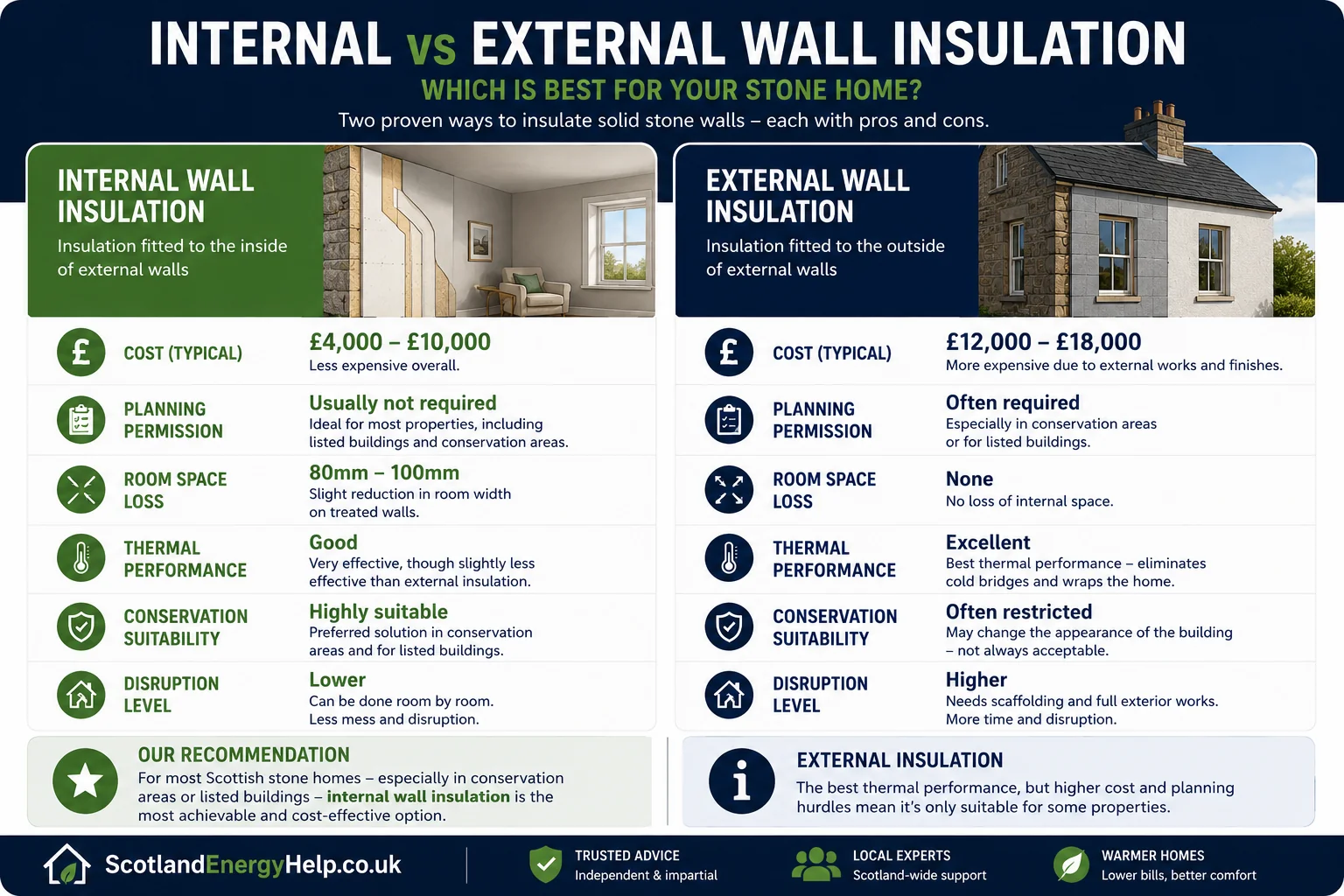
External wall insulation involves attaching an insulating layer — typically mineral wool or expanded polystyrene boards — to the outside face of the wall and covering it with a render or cladding finish. When done well it is the more thermally effective option, as it wraps the building in a continuous insulating layer and eliminates cold bridges at floor and ceiling junctions.
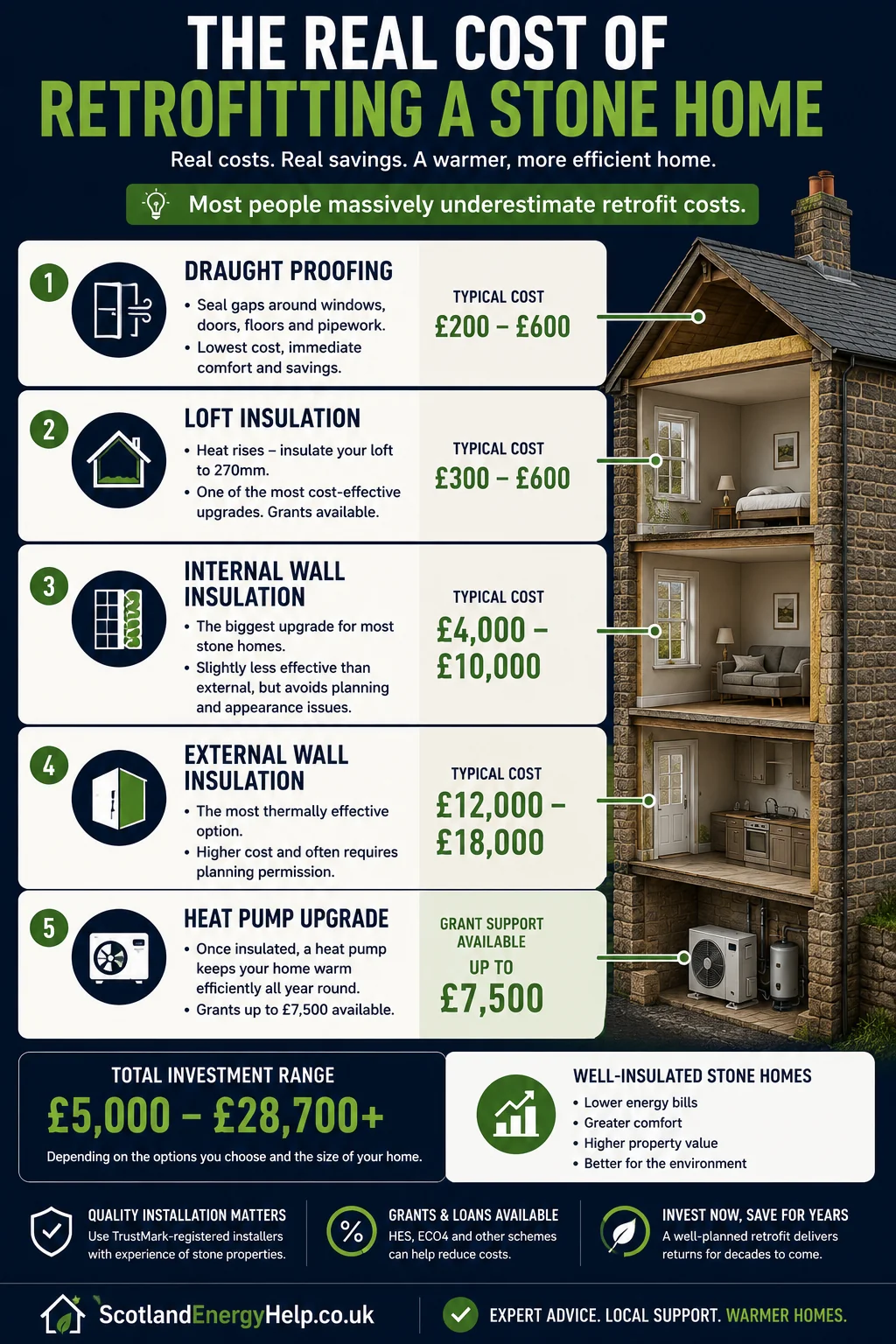
The challenges are significant. Cost for a full house typically ranges from £12,000 to £18,000. Planning permission is often required, particularly for properties in conservation areas — and many Scottish stone homes are in conservation areas or are listed buildings. The appearance of the finished building changes, which is not always acceptable to owners, neighbours or planning authorities.
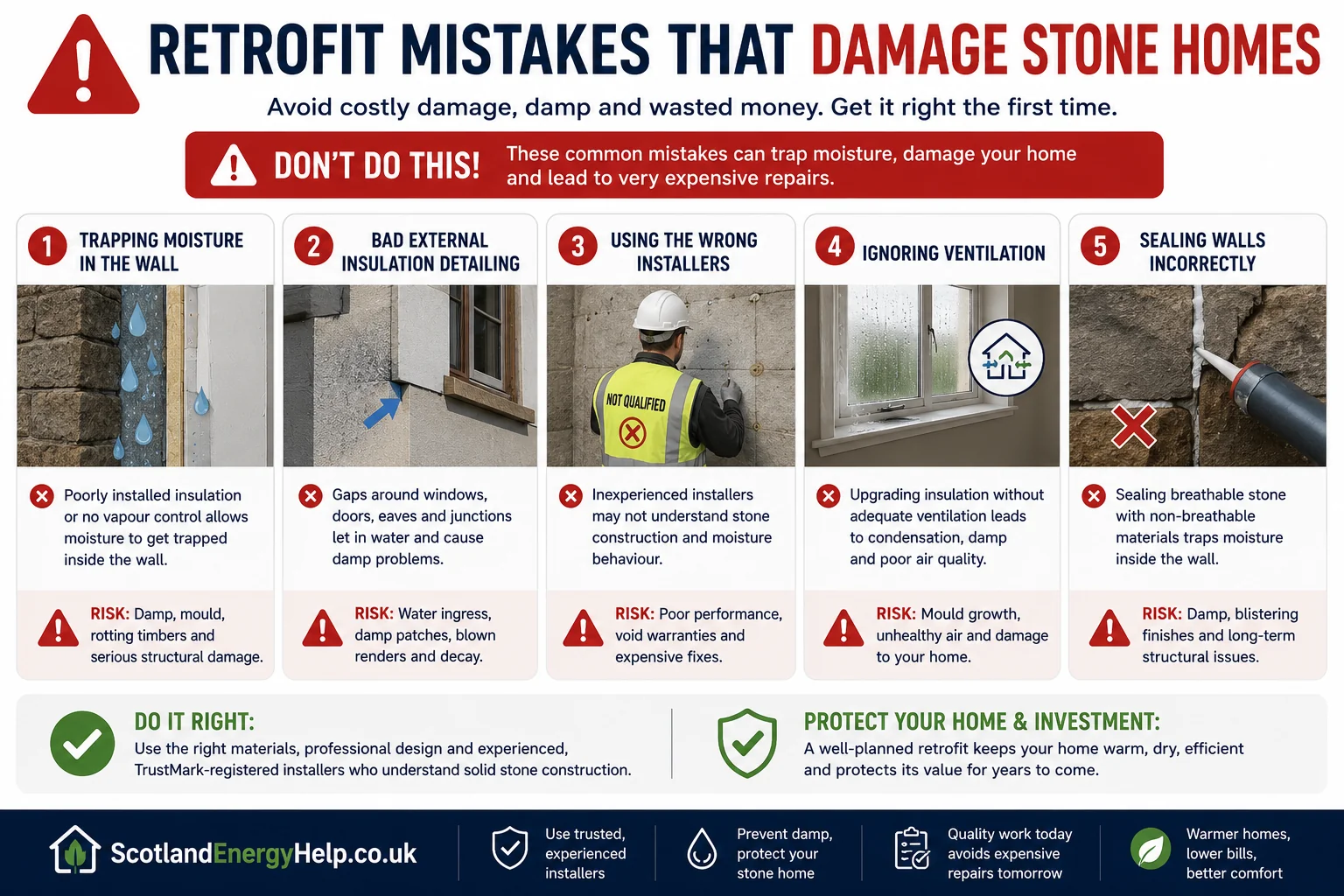
For external wall insulation on a stone home, you need a TrustMark-registered installer with specific experience of solid wall projects. Poor installation — inadequate detailing around windows, doors and junctions — can trap moisture and cause significant damage.
Internal wall insulation
Internal wall insulation applies an insulating layer to the inside face of external walls. The most common approaches are insulated plasterboard fixed directly to the wall, or a timber or metal framing system with insulation installed between the studs and plasterboard over.
The thermal performance of internal insulation is slightly lower than external because it does not address cold bridges at floors and ceilings. However it avoids all of the external planning and appearance issues, can be done room by room rather than all at once, and does not change the external appearance of the building.
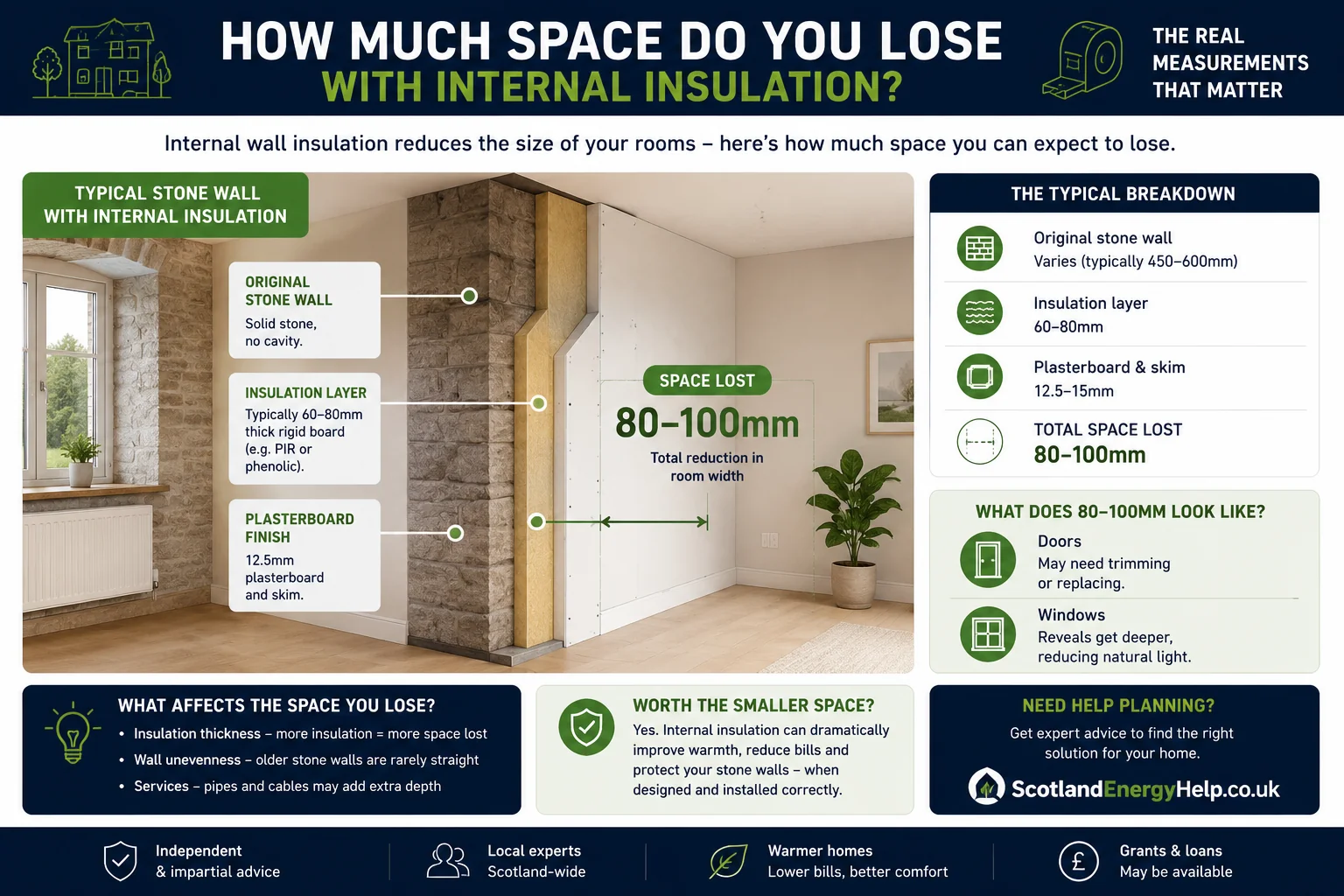
The practical cost for internal wall insulation across a typical stone villa — treating all external walls in main living areas — is typically £4,000 to £10,000 depending on specification and the extent of works. Each treated wall loses 80mm to 100mm of internal width, which in a large Victorian room is barely noticeable.
Internal wall insulation is generally the more achievable option for most stone home owners, particularly those in conservation areas or with listed buildings.
Other high-priority improvements
While wall insulation delivers the largest single improvement, other measures are important components of a complete retrofit.
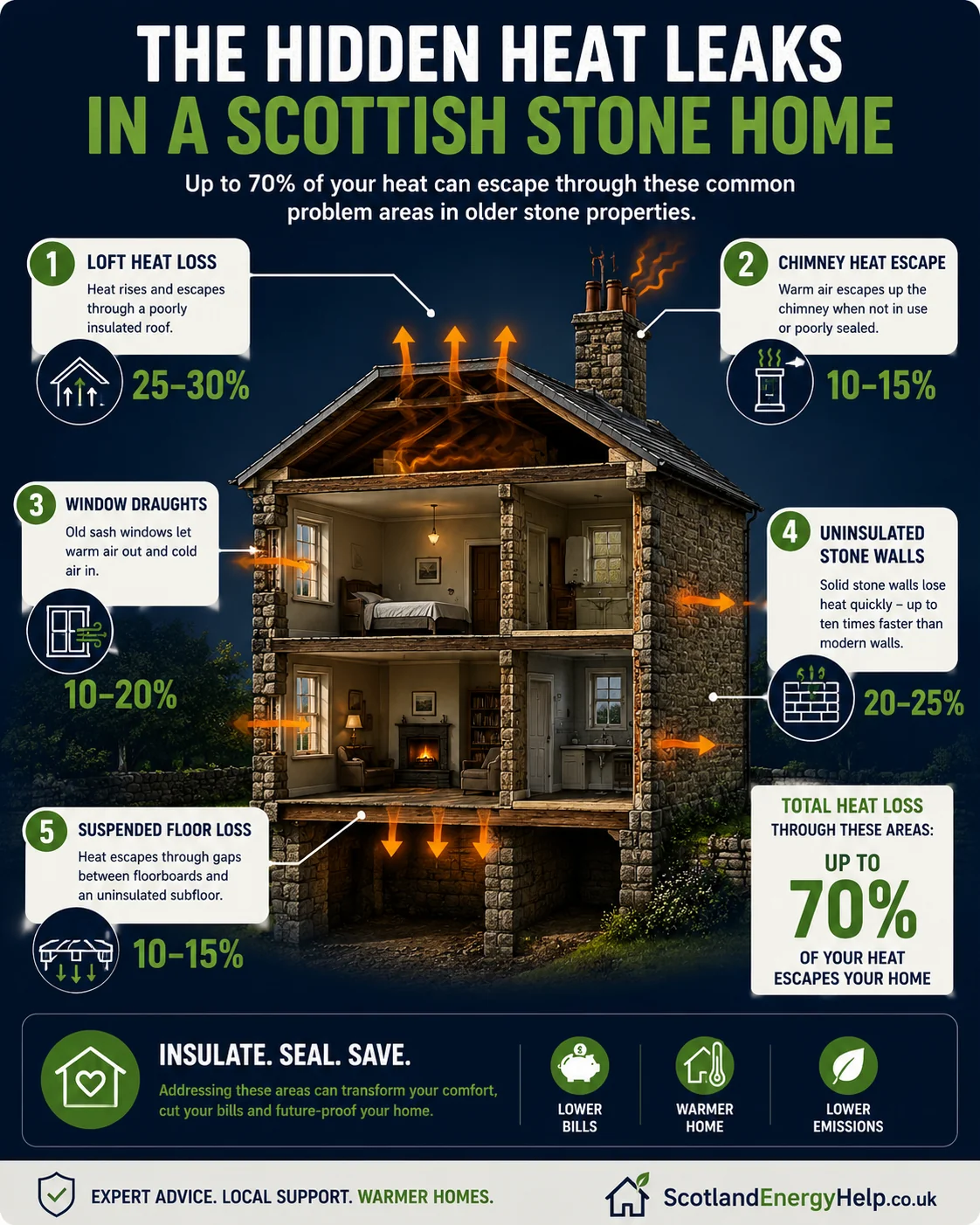
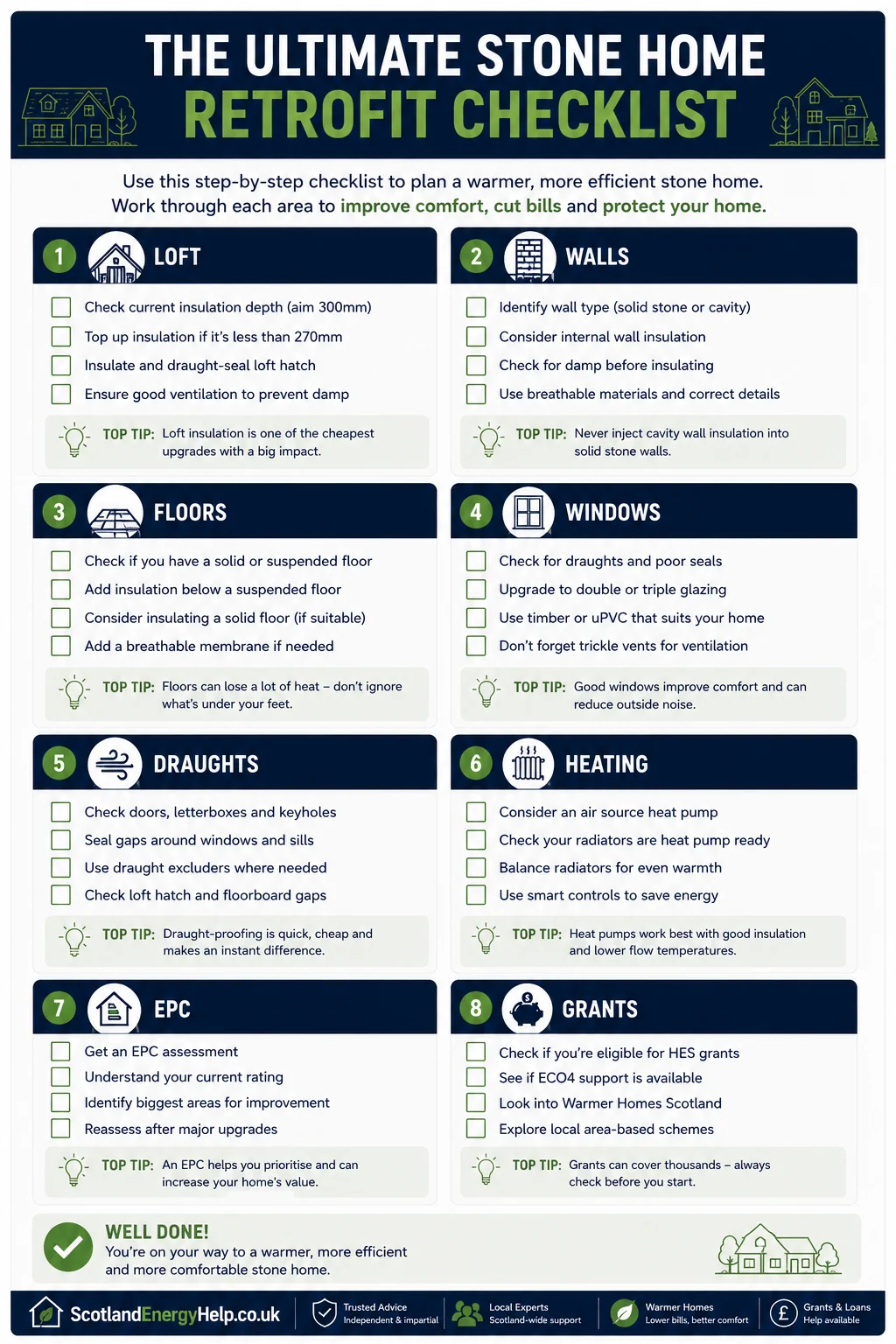
Loft insulation: if your stone home has a pitched roof with accessible loft space, insulating it is the most cost-effective single measure. Heat rises, and a poorly insulated loft loses a significant proportion of the heat generated in the home below. Standard loft insulation to 270mm depth costs £300 to £600 and qualifies for HES grant funding.
Draught proofing: Victorian stone homes are typically draughty. Sash windows, original timber floors, old door frames and gaps around pipework all allow cold air in and warm air out. Professional draught proofing — sealing all of these gaps systematically — costs £200 to £600 and is immediately and noticeably effective. It is the lowest-cost measure with the fastest payback and requires no grant application.
Window upgrades: original single-glazed sash windows lose heat rapidly and are a significant source of draughts. Secondary glazing — a separate glazed panel fitted inside the existing window — preserves the original window appearance (important for listed buildings and conservation areas) while significantly improving thermal performance. Double glazing replacement is possible where planning allows. HES loan funding is available for window improvements.
Floor insulation: suspended timber floors over unheated subfloor voids lose heat through air movement beneath the floorboards. Insulating between the joists from below — where access exists — is effective and relatively inexpensive. Solid ground floors in older stone homes can also be insulated, though this is more disruptive as it involves lifting the floor finish.
Heating system considerations
Once the fabric improvements are in place — or at least planned and partially implemented — consideration of the heating system makes sense.
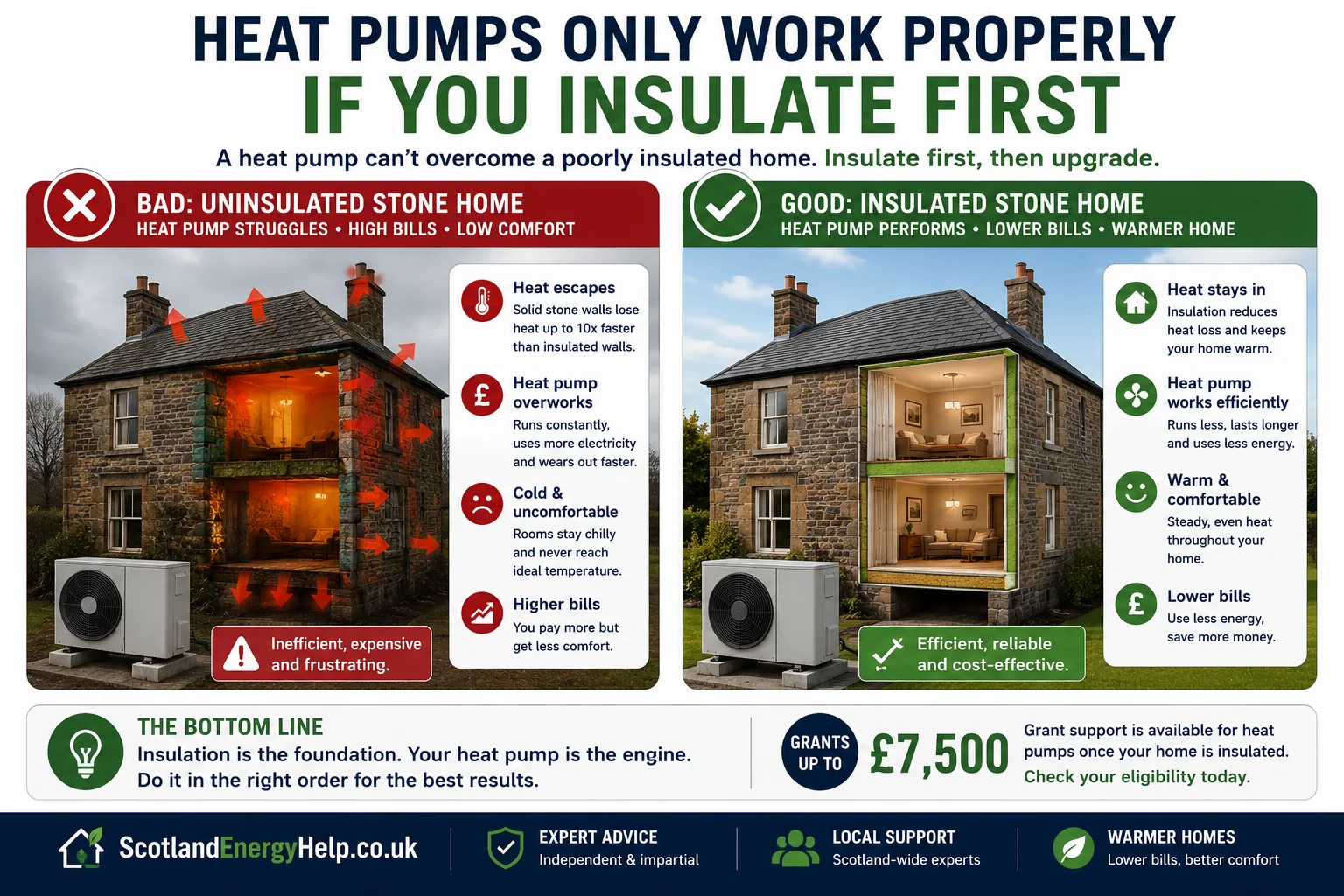
Heat pumps in stone homes: a heat pump can work very well in a well-insulated stone home. The key word is well-insulated. Running a heat pump in a stone home that still has bare stone walls losing heat rapidly will result in the heat pump working harder, operating at lower efficiency and producing higher running costs than expected.
The recommended sequence is: draught proof first, insulate loft and walls to the extent feasible, then consider a heat pump. An honest MCS-certified installer will assess your home's insulation status before recommending a heat pump and advise on any necessary preparatory works.
For stone homes where wall insulation has been carried out and loft insulation is in place, air source heat pumps are generally technically viable. HES grants of up to £7,500 apply.
Boiler replacement: if your stone home has an aging gas boiler and you are not ready to move to a heat pump, replacing an inefficient older boiler with a modern high-efficiency condensing boiler is a worthwhile interim improvement. This does not attract the same HES grant support as heat pump installation but is worth considering as part of a phased approach.
Listed buildings and conservation areas
Many Scottish stone homes are either listed buildings or in conservation areas. This creates additional considerations for retrofit works.
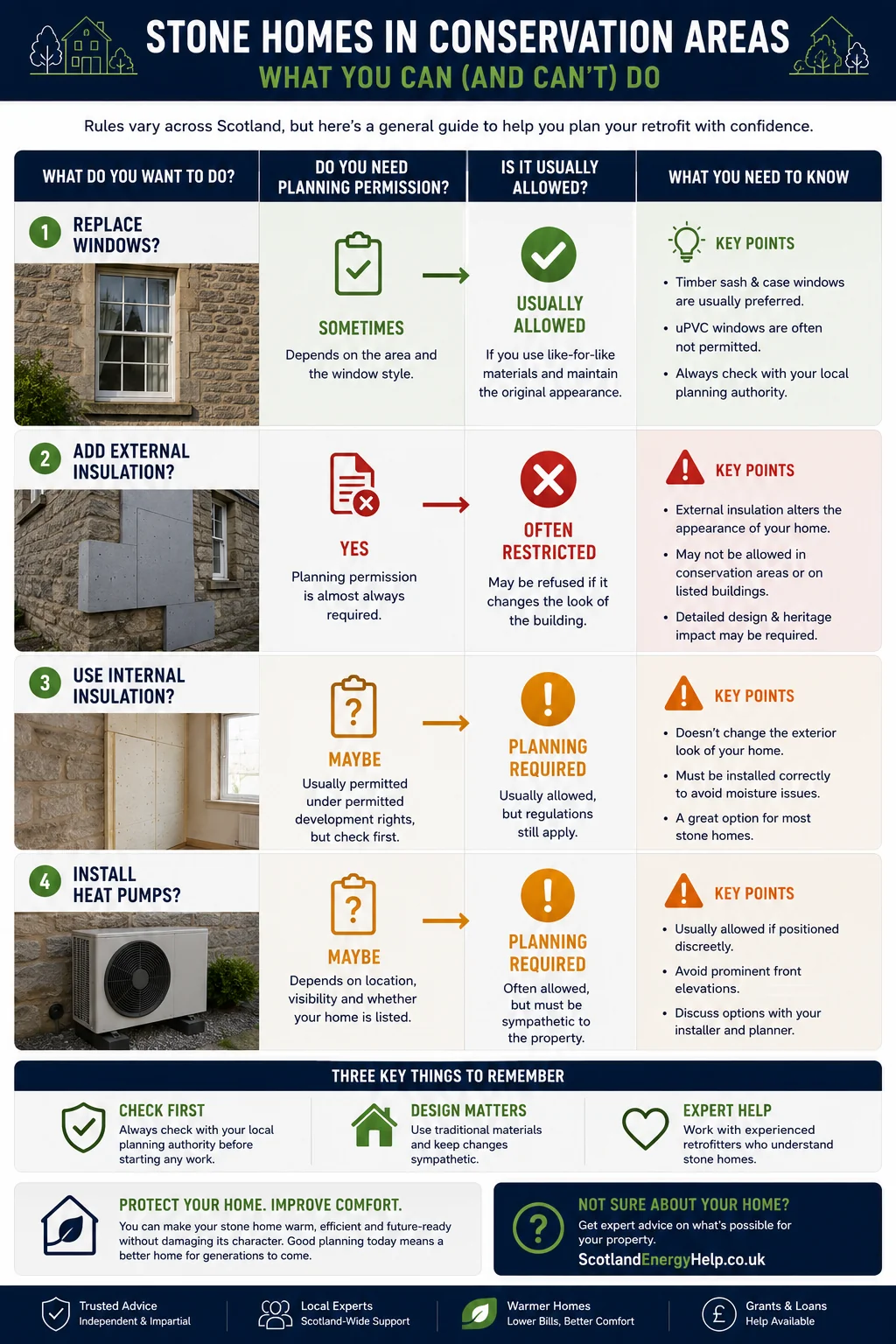
Listed buildings require listed building consent for any works that affect the character of the building, internally or externally. This is in addition to any planning permission required. External wall insulation on a listed sandstone home is unlikely to be approved. Internal insulation carried out sympathetically — not affecting original features — is more straightforward.
Conservation area status restricts certain external changes but does not apply to internal works. Check with your local planning authority before proceeding with any external works on a stone home in a conservation area.
Historic Environment Scotland publishes guidance on energy improvements to traditional buildings that is worth reading if you have a listed property or are in a conservation area. Their technical guidance is more sympathetic to practical retrofit than many owners expect.
Retrofit mistakes that damage stone homes
Stone homes need breathable materials, good detailing and installers who understand moisture movement. The wrong approach can trap damp, damage masonry and waste money.
Poor external detailing, non-breathable finishes, inadequate ventilation and inexperienced installers are some of the most common causes of failed retrofit work on traditional properties.
What retrofitting a stone home can cost
Costs vary widely depending on the measures chosen, the size of the home and whether planning or specialist detailing is needed. Draught proofing and loft insulation are relatively low-cost. Internal wall insulation is a major step up, while external wall insulation is typically the highest-cost fabric measure.
That is why a phased plan matters. Starting with the most cost-effective measures first usually gives the best return and helps you decide whether to move on to larger upgrades later.
Grant support for stone home owners
As an owner-occupier of a stone-built Scottish home, you have access to the following:
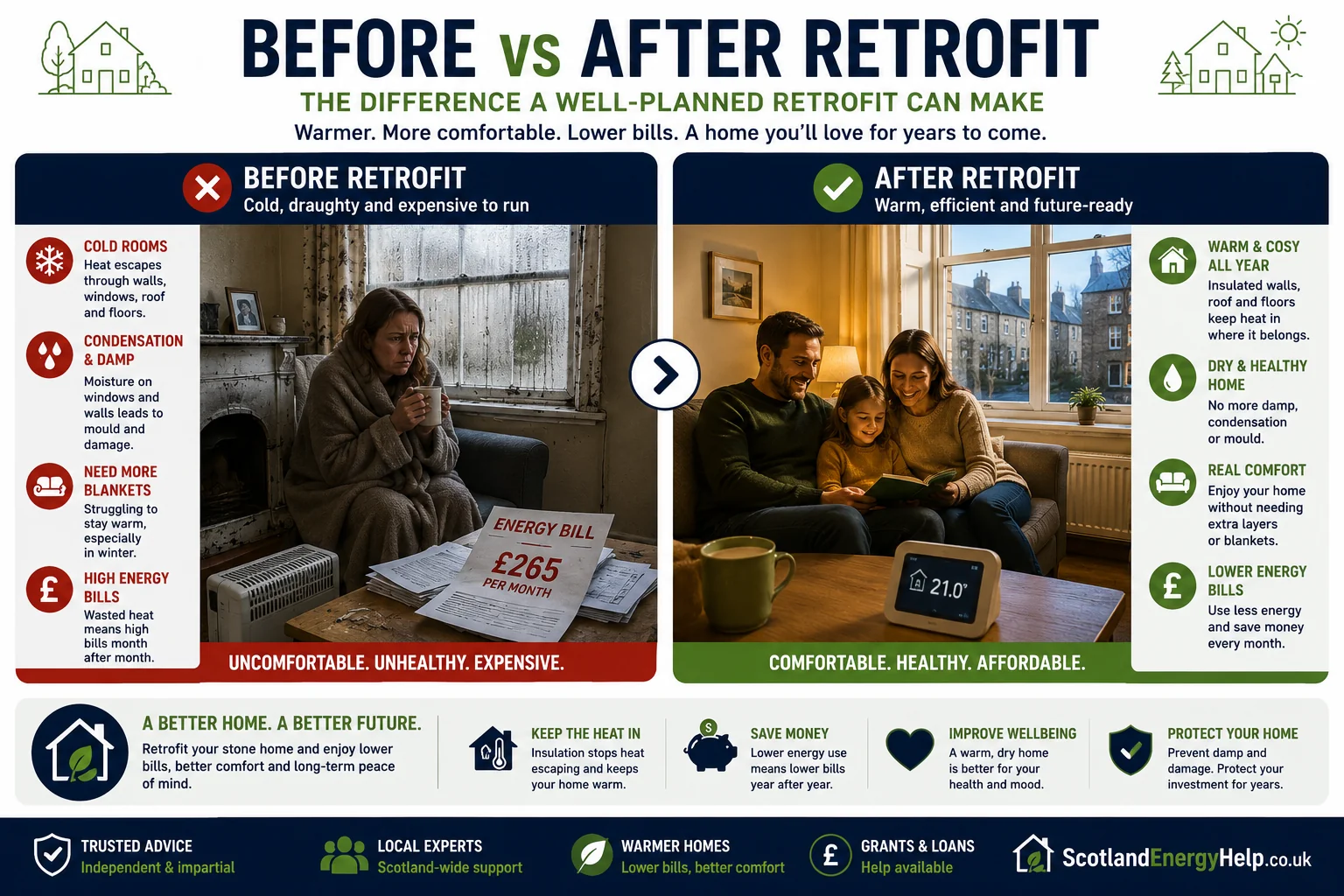
Home Energy Scotland Grant and Loan — grants up to £7,500 per measure and interest-free loans up to £7,500. Applies to wall insulation, loft insulation, heat pumps and other measures. No income test. Rural uplift of £1,500 applies for qualifying postcodes — particularly relevant for rural stone farmhouses and cottages.
Warmer Homes Scotland — fully funded improvements for households meeting income or vulnerability criteria. Where it applies, this can cover insulation and heating works at no cost.
ECO4 — free insulation for households receiving qualifying benefits, delivered through energy suppliers.
Area-based schemes — some Scottish councils run whole-street solid wall insulation programmes targeting older housing stock. These are coordinated by the council and can be significantly more cost-effective than individual action.
A practical sequence for stone home owners
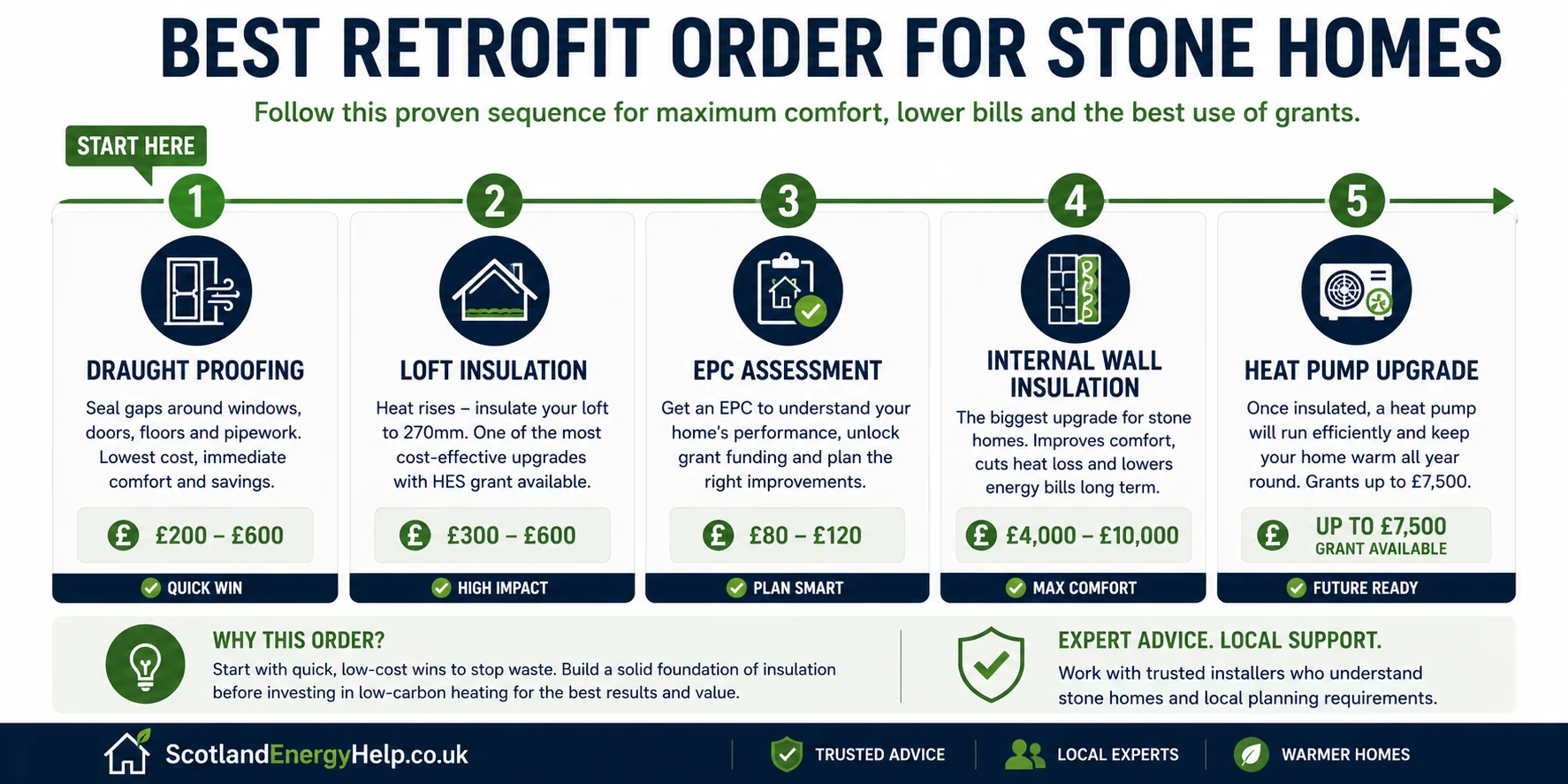
Given the complexity and cost of solid wall insulation, a phased approach makes sense for most stone home owners:
Start with draught proofing — cheap, quick, immediately effective, no grants needed.
Insulate the loft if accessible — low cost, high impact, fully grant-fundable.
Get an up-to-date EPC and a professional retrofit assessment — understand what measures are recommended for your specific property and at what cost before committing to larger works.
Explore internal wall insulation for main living areas — most achievable wall insulation route for most stone homes, HES grant-eligible.
Consider heating system upgrade once fabric improvements are in place or planned — heat pump where insulation is adequate, modern boiler replacement as an interim where not.
Frequently asked questions
Will planning permission be needed?+
External wall insulation almost always requires planning consent on stone homes, especially in conservation areas. Internal wall insulation usually does not, but listed building consent applies if the property is listed.
Will internal wall insulation cause damp?+
If installed by an experienced contractor with proper detailing — vapour control, breathable specification where appropriate, careful junction work — no. Poor installation can cause moisture problems. Always use a TrustMark-registered installer with solid wall experience.
How much internal space do I lose with internal wall insulation?+
Typically 80mm to 100mm off each external wall. In a large Victorian room this is barely noticeable. In a small room it can be more significant — discuss with your installer.
Can I get a heat pump in a stone home?+
Yes, where the fabric is adequately insulated. Running a heat pump in a poorly insulated stone home leads to high running costs. Insulate first, then install. HES grants of up to £7,500 apply.
Is my home listed or in a conservation area?+
Check the Historic Environment Scotland portal for listed buildings and your local council planning website for conservation area boundaries. This determines what external works are possible.
Get this as a branded PDF
Save it, print it, share it with your contractor.